A single afternoon of British Columbia wind or an unexpected Ontario downpour can turn a budget event tent into a liability. Have you ever dealt with a collapsed frame or graphics that fade before the summer ends? Outdoor branding in Canada requires a durability-first approach. Investing in customer printed tents & flags is about more than visibility. It's about ensuring equipment survives the unique challenges of our climate while maintaining a professional appearance.
We agree that your branding should look as sharp on its fiftieth outing as it did on its first. This 2026 guide shows you how to select high-impact displays that balance weather resilience with functional design. Discover how to meet the latest flammability standards under SOR/2024-217 before the November 2026 deadline and navigate the legal requirements for using national symbols. We'll also review material specifications and design tips to ensure your setup remains professional, stable, and compliant for several years of use.
Key Takeaways
- Evaluate aluminum versus steel frames to choose the best material for your specific event frequency and durability needs.
- Learn why 600D fabric is the professional standard for customer printed tents & flags to ensure long-term weather resistance.
- Choose between feather, teardrop, and rectangular flag shapes based on wind conditions and visibility requirements.
- Use vector files and the 3-second rule to create high-clarity graphics that communicate your message instantly.
- Benefit from local Surrey printing expertise for faster production timelines and troubleshooting support.
Defining Customer Printed Tents & Flags for Professional Events
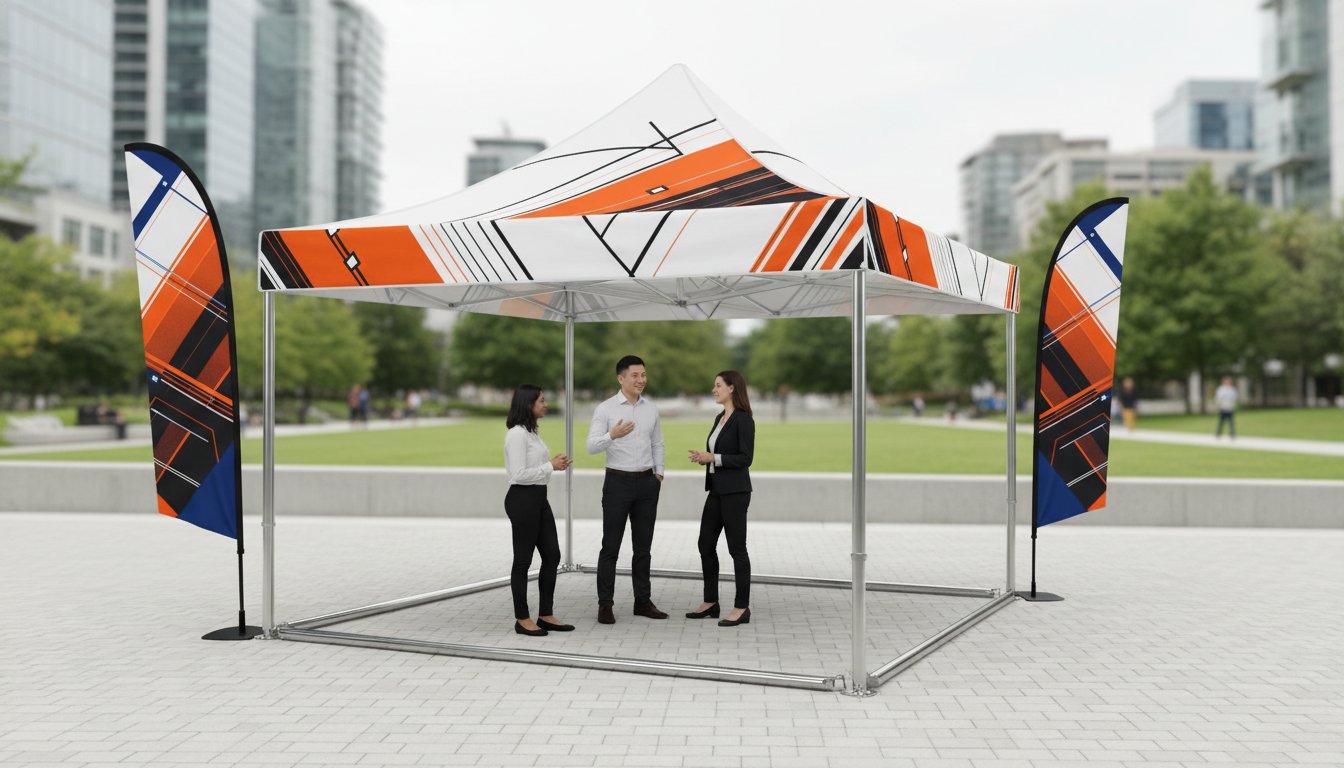
Commercial-grade equipment is a business asset; it's not a temporary purchase. Customer printed tents & flags provide a structural anchor for outdoor marketing and community engagement. These products differ significantly from the retail-grade kits found at local big-box stores. Retail tents often use thin polyester and lightweight steel that buckles under pressure. Professional versions prioritize high-density fabrics and reinforced aluminum frames. This distinction ensures your branding remains upright and professional during a typical Canadian weather shift.
A branded centre acts as a navigation point for your audience. In a sea of generic white tents, a fully printed canopy serves as a landmark. This visibility is vital for lead generation and brand recall. If a visitor can't find your station within three seconds of scanning the area, they will likely move to a competitor. High-visibility flags solve this by adding a vertical dimension to your footprint, catching the eye from several hundred metres away. Using customer printed tents & flags together creates a layered visual experience that communicates competence and expertise.
To see how Zodiac Event Displays creates high-impact branding for professional events, click here for further design inspiration.
To complement this visual branding with high-end technical support, Straight Street Event Services provides specialized production solutions that ensure your event's audio-visual and technical requirements are as professional as your physical presence.
The Core Components of an Event Kit
A standard professional setup usually begins with a 10x10 pop-up canopy. This size offers 100 square feet of sheltered space, which is the standard footprint for most Canadian outdoor markets. While 10x10 is the baseline, larger 10x15 and 10x20 configurations are popular for organizations that require more service area or internal storage. Promotional flags provide the necessary vertical advantage. These flags catch the wind and attract attention from across a crowded field. To complete the perimeter, many organizations integrate vinyl banners. These banners attach to tables or fences, reinforcing the brand at eye level and defining the boundaries of your space.
Why Professional Branding Matters in 2026
The Canadian promotional products industry is projected to reach $3.0 billion in 2026. With 5,800 businesses competing in this market, a cohesive visual identity is mandatory. A professional booth creates a psychological sense of stability and trust. When graphics are applied using a Dye-sublimation printing process, the ink bonds directly with the fabric fibres. This prevents the peeling and cracking common in cheaper alternatives. Investing in high-quality hardware allows you to realize a better ROI. You won't need to replace the entire kit every season. Instead, you can reuse the durable frames and simply update the fabric skins as your marketing message evolves. This modular approach also supports the 72% of Canadian consumers who prefer sustainable, long-lasting promotional items over disposable ones.
Frame and Fabric Specifications: Selecting for Canadian Climates
Selecting customer printed tents & flags for the Canadian market requires an understanding of material science. Our climate varies from intense UV exposure in the prairies to constant humidity in the Lower Mainland. Standard retail equipment often fails because it ignores these variables. A professional-grade kit must prioritize structural geometry and fabric density to remain functional for more than one season. When evaluating your options, focus on the technical specifications of the frame and the chemical treatments applied to the canopy fabric.
Frame Materials: Performance and Portability
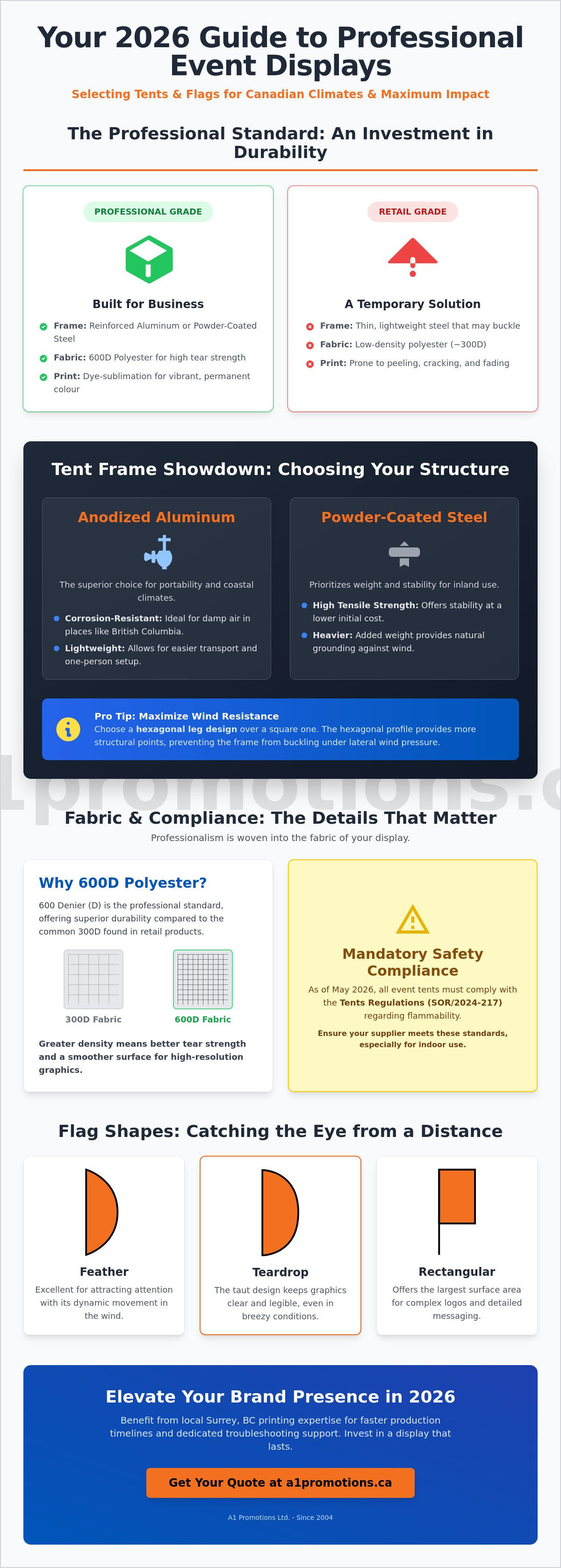
Powder-coated steel frames provide high tensile strength at a lower initial cost. These are effective for inland organizations that prioritize weight for stability. However, steel is prone to rust if the coating is scratched. Anodized aluminum is the superior choice for British Columbia. It's naturally corrosion-resistant, making it ideal for the damp coastal air. Aluminum is also significantly lighter. This allows a single person to organize the setup without assistance. For maximum wind resistance, choose hexagonal leg designs over square ones. The hexagonal profile offers more surface area and structural points, which prevents the frame from buckling under lateral pressure.
Fabric Quality and Print Longevity
Fabric density is measured in Denier (D). While 300D is common in consumer products, 600D polyester is the professional standard for customer printed tents & flags. This thickness provides the necessary tear strength to withstand wind loads. It also offers a smoother surface for high-resolution graphics. Ensure your fabric meets the latest Canadian safety standards. As of May 2026, all tents must comply with the Tents Regulations (SOR/2024-217) regarding flammability. This is mandatory for participation in indoor trade shows and many municipal outdoor markets.
Longevity depends on protective coatings. UV50+ protection is essential to prevent fabric degradation and ink fading. Without UV inhibitors, polyester becomes brittle and prone to tearing within months of direct sun exposure. Water resistance is equally critical. Professional canopies feature a Polyurethane (PU) coating and heat-sealed seams to ensure the interior remains dry during a downpour. If you want to browse professional event equipment, look for these specific technical ratings. Combining 600D fabric with a hexagonal aluminum frame creates a setup that survives the Canadian elements while maintaining a clean, professional aesthetic for years.
Comparing Flag Shapes: Feather, Teardrop, and Rectangular
Flags provide the vertical visibility that a canopy alone cannot achieve. While the tent serves as your service hub, flags act as beacons to draw traffic from the perimeter of an event. Choosing the correct geometry for your customer printed tents & flags depends on your logo's aspect ratio and the expected wind conditions at your venue. Each shape offers distinct aerodynamic properties and graphic surface areas.
- Feather Flags: These are the most versatile option. The long, vertical structure provides ample space for large typography and brand colours. They offer a slight sway in the wind, which helps attract the eye without compromising the legibility of the message.
- Teardrop Flags: The fabric is held under constant tension across a curved frame. This prevents the flag from flapping aggressively in high-wind environments like the BC coast. The taut surface ensures your logo is always visible, even when there is no breeze.
- Rectangular Flags: This shape maximizes the printable area. It's the best choice for text-heavy branding or when you need to list specific services or sponsors. They resemble traditional flags but remain open and readable regardless of wind speed.
Choosing the Right Shape for Your Logo
Your brand assets dictate the best flag choice. A round or square logo fits naturally within the bulbous top of a teardrop flag. If your logo is horizontal, a feather or rectangular flag prevents awkward cropping. It's important to centre your graphics carefully to avoid losing elements in the pole sleeve or the curved edges. Consider double-sided printing for 360-degree visibility. This involves two layers of fabric with a block-out liner. It ensures your message doesn't appear mirrored from the back. For a balanced aesthetic, match your flag height to your tent size. A 14-foot flag paired with a 10-foot tent creates a professional, tiered visual hierarchy.
Hardware and Base Stability
Stability starts with the pivot point. Professional flag poles use ball-bearing swivels. These allow the flag to rotate 360 degrees with the wind. This rotation reduces torque on the pole and prevents the fabric from tangling. Base selection must match the terrain. Ground spikes are standard for grass or soil. For concrete or indoor trade shows, use a heavy-duty cross base. In the Lower Mainland, wind gusts can be unpredictable. Always add a water weight bag to your cross base for outdoor setups on hard surfaces. This provides the necessary counterweight for 14-foot or 17-foot displays. If wind speeds exceed 40 km/h, it's a standard safety practice to temporarily strike the flags to prevent hardware damage.
Design Guide: Optimizing Graphics for Large Format Printing
Designing for customer printed tents & flags requires a technical shift from digital or small-scale print standards. A logo that appears sharp on a business card often reveals flaws when expanded to a 10-foot canopy. Vector files are the mandatory format for high-impact production. Because vector graphics use mathematical paths rather than pixels, they allow for infinite scaling without loss of clarity. Submitting low-resolution raster files results in visible pixelation that can undermine your professional credibility at an event.
Effective signage relies on the 3-second rule. A passerby must identify your brand and primary call-to-action within three seconds of scanning your booth. Keep your messaging concise. High-contrast colour palettes are essential for outdoor legibility; dark text on light backgrounds remains readable from the furthest distance. Avoid overly decorative or thin fonts, as these tend to blur together when viewed from across a field or parking lot.
Technical Design Requirements
Large format output for customer printed tents & flags requires a target resolution of 100 to 150 DPI at the final size. While smaller items require 300 DPI, these settings maintain sharpness on large fabric surfaces while keeping file sizes manageable. Always respect established safe zones. Keep your primary logos and text at least 5 centimetres from the edges to ensure they aren't lost in the seams or obscured by the structural frame hardware. This precision ensures a professional finish that reflects your organization's attention to detail.
Branding Consistency Across Products
A unified event footprint maximizes brand recall. Ensure your canopy colours are calibrated to match your custom printed t shirts so your staff and structures present a single identity. Consistent font usage across flags, banners, and table covers creates a professional visual hierarchy. For maximum visibility, place your website URL on the tent valance. This eye-level placement ensures your contact information is accessible even when the booth is crowded.
Ready to finalize your layout? Submit your design files to the A1 Promotions Ltd. team in Surrey for a technical review before production begins.
Sourcing Locally: The A1 Promotions Ltd. Advantage in Surrey
Local procurement ensures accountability. When you invest in customer printed tents & flags, having a local partner in the Lower Mainland reduces logistics risks. National online vendors often lack the ability to provide physical troubleshooting if a frame arrives damaged or a print colour is off-spec. Working with a surrey printing ltd expert provides a direct line to the production team. This proximity allows for faster turnaround times and the opportunity to inspect material samples before committing to a large order. Expert consultation from A1 Promotions Ltd. helps you get the technical details right the first time, preventing costly errors on custom-manufactured hardware.
A cohesive event presence extends beyond the canopy. You can integrate your outdoor setup with high-quality corporate gifts Surrey organizations use for attendee engagement and lead generation. If your event includes a competition or formal recognition ceremony, sourcing trophies and medals from the same provider ensures consistent branding and simplified billing. Managing all promotional assets through a single facilitator like A1 Promotions Ltd. reduces administrative friction and ensures your visual identity remains uniform across different materials.
Personalized Service from A1 Promotions Ltd. in British Columbia
A1 Promotions Ltd. has operated as a family-owned business since 2004. This longevity in the Surrey market translates to a deep understanding of local branding requirements and weather challenges. We maintain two physical locations in Surrey: Hyland and Newton. Local pickup options eliminate the shipping delays and potential damage associated with long-distance courier services. Choosing a local provider keeps your marketing budget within the regional economy while ensuring you receive premium, weather-tested branding solutions tailored for the BC climate.
Next Steps: Planning Your 2026 Event Season with A1 Promotions Ltd.
Successful outdoor branding requires early preparation. For the 2026 season, aim to finalize your hardware requirements at least four to six weeks before your first event. This allows sufficient time for artwork verification and production. Use this checklist to organize your customer printed tents & flags order with A1 Promotions Ltd.:
- Confirm frame material (Aluminum is recommended for BC humidity).
- Verify fabric compliance with SOR/2024-217 flammability standards.
- Provide all logos in vector format to avoid pixelation.
- Specify Pantone colours to ensure exact brand matching across all items.
- Select appropriate bases for your primary venue terrain (spikes vs. weighted bases).
Ready to organize your display? Request a technical quote to receive current availability and lead times for the 2026 season. Preparing your artwork early ensures your team is ready for the first outdoor market of the year.
Equip Your Organization for the 2026 Event Season
Successful outdoor branding requires a balance of structural integrity and high-resolution design. By prioritizing weather-resistant materials and technical precision, you ensure your event equipment remains a reliable business asset for years. Adhering to professional manufacturing standards and utilizing correct vector file formats protects your brand's image across the competitive Canadian market. Investing in high-quality customer printed tents & flags is the most efficient way to secure a long-term return on your promotional budget while maintaining a professional presence.
A1 Promotions Ltd. has been family-owned since 2004; we specialize in high-durability gear built for the unique Canadian climate. With two convenient Surrey locations, we provide the local expertise and technical support needed to organize a cohesive and impactful event footprint. Whether you require a single 10x10 canopy or a full suite of vertical flags, our team is ready to assist with your specific technical requirements. Request a custom quote for your event tents and flags today! Your organization deserves a display that remains stable, compliant, and vibrant for years to come.
Frequently Asked Questions
What is the difference between a custom tent and a 'customer printed' tent?
A customer printed tent specifically refers to the application of bespoke graphics and logos onto the canopy fabric. While "custom" can refer to unique frame sizes or basic fabric colours, "customer printed" denotes the use of technical processes like dye-sublimation to display your unique brand assets. This ensures your identity is visible from every angle of the event space.
How do I choose between a steel and an aluminum tent frame for BC weather?
Aluminum is the preferred material for the damp coastal weather in British Columbia. While steel frames provide high tensile strength at a lower cost, they are prone to oxidation in high-humidity environments. Anodized aluminum frames are corrosion-resistant and lighter, making them easier to transport between Surrey and other Lower Mainland venues.
Can I use my custom flags indoors at trade shows?
You can use promotional flags indoors by utilizing a heavy-duty cross base instead of a ground spike. This hardware swap allows for stable positioning on concrete or carpeted trade show floors. Always verify that your fabric meets the flammability requirements of the specific venue, as indoor regulations are often stricter than outdoor ones.
How long does the printing on custom tents and flags typically last?
Professional printing on customer printed tents & flags typically maintains its vibrancy for 2 to 5 years. Longevity depends on frequency of use and exposure to direct UV rays. Utilizing 600D polyester with UV-inhibitors prevents the fabric from becoming brittle, while dye-sublimation printing prevents the graphics from cracking or peeling over time.
What size of custom tent is standard for most Canadian outdoor markets?
The 10x10 configuration is the standard footprint for the majority of Canadian outdoor markets and community festivals. This size provides 100 square feet of covered space, which aligns with most municipal vendor bylaws. Organizations requiring additional storage or a larger service counter often upgrade to a 10x20 setup.
How do I properly clean and store my printed tent canopy?
Use a soft sponge with mild detergent and warm water to clean the canopy fabric. Avoid abrasive brushes or high-pressure washers that can strip the water-resistant Polyurethane coating. It is critical to let the fabric dry completely before storage. Folding a damp tent will result in mildew growth and can compromise the integrity of the print.
Are the flags and tents easy for one person to set up?
Most professional pop-up tents are designed for rapid assembly, but a two-person team is more efficient. One person can technically organize the setup by expanding the frame from opposite corners, but having a partner prevents unnecessary torque on the internal trusses. Flags are easily managed by a single individual in under two minutes.
Do you offer design assistance for customer printed tents & flags in Surrey?
We provide technical design reviews and file verification at our two Surrey locations. Our production team reviews your vector assets to ensure they meet the resolution requirements for large-format printing. This step is vital for organizing a professional-looking display and avoiding pixelation on your finished customer printed tents & flags.


