
Choosing swag that people will actually use starts with the recipient, not the novelty of the item. Think about what they carry, wear, drink from or reach for during a typical day, then choose merchandise that fits that routine.
A promotional item can be forgotten when it doesn’t suit its audience or occasion. The right category for employees may differ from what works for event attendees, students or clients. Even a practical product needs a clear purpose, and its branding should be visible without getting in the way.
This guide compares useful merchandise by audience, everyday context and purpose, so you can narrow your options and prepare a clear custom merchandise brief. It covers drinkware, tote bags, branded apparel and stationery, with practical questions to help assess each category.
A1 Promotions Ltd. is a family-owned Canadian business serving customers since 2004, with custom branding and decoration for promotional merchandise and apparel. Use the ideas ahead to plan merchandise with a practical role beyond the giveaway itself.
Key Takeaways
- Start with the recipient’s routine and the purpose of the giveaway, not novelty or logo placement.
- Compare apparel, drinkware, bags and desk essentials by where they’ll be used and who they’re intended for.
- Use relevance, function, portability and branding fit to narrow your shortlist and avoid unwanted clutter.
- Choose swag that people will actually use by defining the audience, occasion, use context, product and artwork before preparing your merchandise brief.
- A1 Promotions’ apparel, drinkware, bags and stationery categories can support a coordinated branded merchandise plan.
What makes swag people will actually use worth choosing?
Useful swag is branded merchandise that fits a recipient’s routine and serves a practical purpose. That might mean carrying everyday essentials, taking notes at work or having a drink container on hand during a commute. A logo alone doesn’t make an item useful. Its value depends on whether the product suits the person, setting and task it’s intended for.
Branded items are easy to overlook when they don’t match recipients’ needs or habits. Novelty may draw attention at first, but it doesn’t make an item a good fit. The broad category of promotional merchandise includes many kinds of branded goods. To choose well, look beyond the imprint and identify the role the item could play in someone’s day.
Use these practical considerations when planning company merchandise:
How to judge whether a branded item fits everyday life
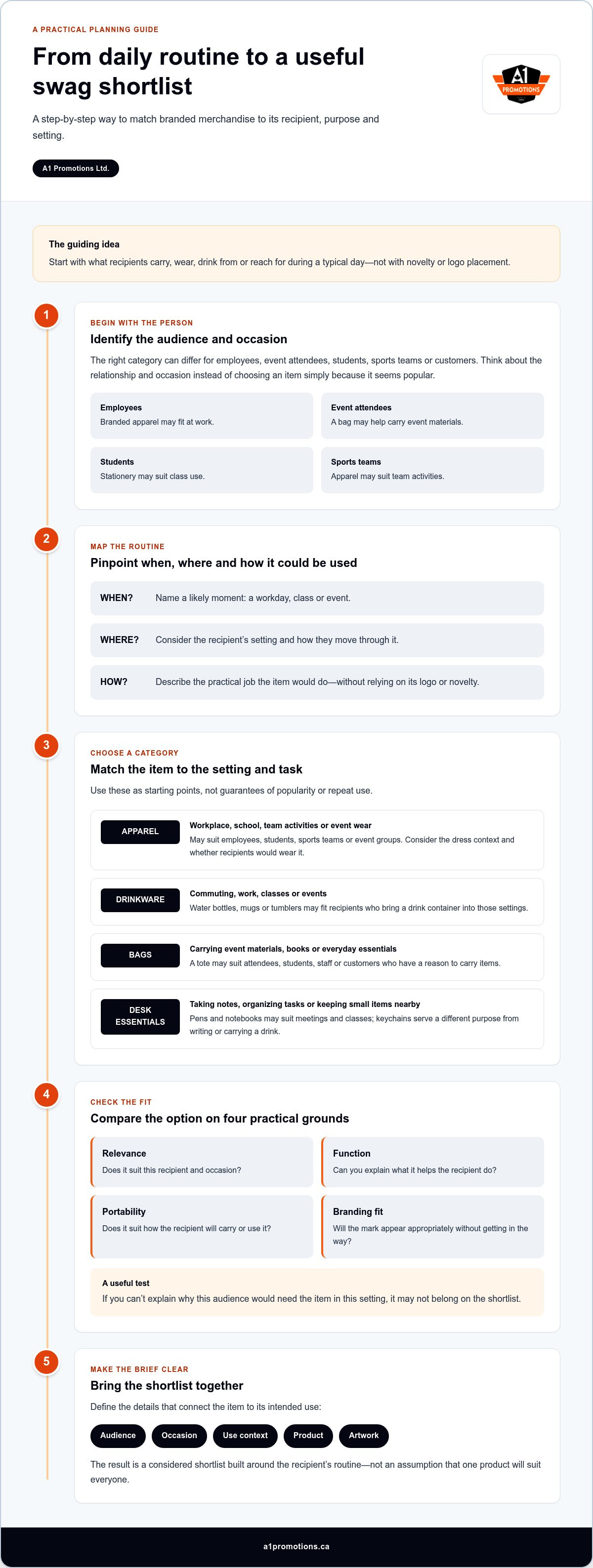
Start with the recipient’s routine. Identify when the item could be used, where it would go and what job it would do. A notebook may suit a planning session; a tote bag may be useful at an event where people are carrying materials. These examples help assess fit, but they don’t guarantee repeat use. Ask: Could this item meet a familiar need for this audience?
- When? Name a likely moment of use, such as a workday, class or event.
- Where? Consider the recipient’s setting and whether the item fits how they move through it.
- How? Describe its function without relying on the logo or novelty to justify the choice.
Why audience and occasion matter more than novelty
The same product can suit one group and miss another. Employees may wear branded apparel at work; event attendees may need a bag for carrying materials. Students may use stationery for class, while a sports team may need apparel suited to team activities. A customer gift should make sense for the relationship and occasion, rather than being chosen simply because it seems popular.
Compare options by context, function and branding. Context is where the item belongs; function is what it helps the recipient do; branding is how the mark will appear and whether it suits that use. These criteria help you shortlist swag that people will actually use without assuming any product will be a universal favourite.
Which useful swag categories belong on your shortlist?
Choose a category by matching the item to the recipient’s setting and likely task. The options below are starting points, not guarantees of popularity or repeat use. For broader planning considerations, see this Canadian promotional products branding guide. PPAI’s What Consumers Want Next report also explores usefulness and design in how people value promotional products.
| Category | Possible use context | May suit |
|---|---|---|
| Apparel | Workplace, school, team activities or event wear | Employees, students, sports teams or event groups |
| Drinkware | Commuting, work, classes or events | Recipients who bring a water bottle, mug or tumbler into those settings |
| Bags | Carrying event materials, books or everyday essentials | Attendees, students, staff or customers with a reason to carry items |
| Desk essentials | Taking notes, organizing tasks or keeping small items nearby | Office teams, students or event participants |
Apparel and bags for visible, practical branding
T-shirts may suit casual events, school activities or team settings. Hoodies can be considered when a group wants a warmer layer for shared activities. Corporate clothing, such as branded polos or jackets, may fit staff at work or at an organization’s event. Before choosing apparel, consider the dress context and whether recipients would wear the item. For more apparel-specific considerations, read this custom clothing guide for Canada.
A tote bag makes sense when recipients have something to carry, such as event materials, books or everyday essentials. Its purpose is clearest when the occasion gives people a reason to use it. Keep the branding appropriate to how and where the bag may be carried.
Drinkware and desk essentials for regular routines
Water bottles, mugs and tumblers can suit settings where people bring drinks with them, such as work, school or a commute. Pens and notebooks are useful to consider for note-taking, meetings and classes. Keychains are compact options for recipients who use keys, though they serve a different purpose from something designed for writing or carrying a drink.
Narrow your shortlist by asking what the recipient will be doing and where the item will be used. A1 Promotions Ltd. offers branded apparel, bags, drinkware and stationery to support a coordinated selection. Explore custom promotional merchandise options as you plan for your audience.
How do you compare swag options without creating unwanted clutter?
A logo doesn’t make an item useful. Before choosing, check whether it matches the recipient, serves a practical purpose, suits how it will be carried or used, and gives the brand an appropriate presence. If you can’t explain why this audience would need the item in this setting, it may not belong on the shortlist.
| Category | Suitable context | Possible limitation | Design consideration |
|---|---|---|---|
| Desk essentials | Office work, meetings or study | May be less relevant to recipients who don’t work or study at a desk | Keep text and logos clear at a compact scale |
| Apparel | Workplaces, school activities or team settings | Recipients’ preferences and dress contexts vary | Place branding where it suits the garment and intended use |
| Drinkware | Work, classes, events or travel | May not suit recipients who don’t bring a drink container | Ensure the artwork works with the item’s shape and usable area |
| Bags | Events, school or carrying everyday items | May add little value when recipients have nothing to carry | Balance a readable mark with space for the bag’s practical use |
Match the item to the recipient and setting
For a workplace audience, compare desk essentials with apparel or drinkware based on the needs of the workday. At an event, consider whether attendees can carry the item alongside their other belongings and use it comfortably in the venue. For teams and schools, apparel or another coordinated item may support a shared identity if it fits the group’s activities and purpose. Let the setting narrow the options instead of treating it as a detail to add after choosing a product.
Balance usefulness with a clear, restrained brand presence
Branding should identify the organization without interfering with the item’s function. A large logo isn’t automatically more effective; a clear, well-placed mark may better suit how the item will be seen and used. Consider the product’s shape, material and available decoration area when preparing artwork. The decoration method should suit both the product and the design, rather than applying the same treatment to every item.
Compare finalists against four questions: Is the item relevant to this audience? Does it have a clear function? Is it practical to carry or use in the intended setting? Does the branding fit? A weak match on several points may signal an item that adds clutter instead of serving the brief. Explore custom promotional merchandise from A1 Promotions Ltd. when planning your shortlist.
How can you turn a swag shortlist into a clear merchandise brief?
Set the purpose before choosing a product category. A concise brief identifies who the merchandise is for, what it should support and how the artwork relates to the item. This keeps decisions focused on recipients’ needs instead of starting with a product and trying to make it fit.
Start with recipients, purpose and occasion
Work through these steps in order. Each answer helps narrow the next decision:
- Define the recipients. Identify the group, such as employees, event attendees, students, customers or a sports team. Note what they have in common and where their routines differ.
- Set the purpose. Decide what the merchandise should support, such as event participation, team identity, workplace apparel or an everyday task. Keep the purpose specific enough to guide product selection.
- Name the occasion. Note whether the item is for a one-time event, a school activity, a team programme or ongoing workplace use. An event giveaway and apparel intended for team or work use call for different considerations.
- Describe the use context. State where and how the recipient might use the item. Will it be carried during an event, worn at work or used for notes during a meeting?
- Select the product category. Choose an item that serves the stated purpose in that context. If a T-shirt fits the audience and occasion, use this custom printed T-shirt guide for related planning considerations.
Prepare artwork and product details for customization
Once the product category is clear, gather the information needed to plan the branding. Include the logo file, brand colours, preferred placement and any artwork requirements. Note the intended product category and how the item will be used, so the design can be considered in context.
Product and artwork decisions work best together. A layout that suits a T-shirt may need a different approach on a mug or tote bag. A1 Promotions provides custom branding and expert decoration services to help align the selected merchandise with its artwork and intended use.
Use the finished brief to keep decisions consistent: recipient, purpose, occasion, use context, product and artwork. Plan custom branded merchandise with A1 Promotions.
How can A1 Promotions help make useful swag part of your brand?
Useful branded merchandise starts with a match between the recipient, the occasion and the item’s purpose. A1 Promotions helps organizations bring those choices together across apparel and promotional merchandise, including tote bags, water bottles, pens, notebooks, mugs and tumblers, and keychains. These categories can support a coordinated merchandise plan for different audiences or uses.
A1 Promotions is a family-owned Canadian business serving customers since 2004. Its approach combines premium-quality sourcing with expert decoration, so the product and its branding can be considered together. Start by choosing merchandise that fits the brief, then plan how the organization’s brand should appear on it.
Bring product choice and customization together
A logo’s placement and presentation should suit the product and its intended use. Artwork for apparel may need a different treatment from branding for drinkware, stationery or a tote bag. A1 Promotions offers custom apparel and promotional merchandise, with expert decoration to align the branding with the chosen category. Friendly advice and dedicated support help keep planning focused on audience, purpose and product fit.
When coordinating several categories, a one-stop-shop approach can help bring a consistent branded presence across items. For example, a workplace brief might include corporate clothing alongside mugs or notebooks, while an event plan may call for tote bags and water bottles. Assess each item on its own merits while keeping the overall brand presentation in view.
Take the next step with a focused brief
Prepare a short outline of your needs to make the planning discussion more focused. Include:
- Audience: Who will receive the merchandise?
- Occasion: What event, workplace activity or organizational purpose is it for?
- Preferred categories: Which items are under consideration, such as apparel, bags, drinkware or stationery?
- Branding needs: What logo, brand colours and placement considerations should guide customization?
A focused brief gives A1 Promotions a clear starting point for planning swag that people will actually use. Organizations across Canada can bring their audience, occasion, preferred categories and branding needs together to develop custom merchandise.
Discuss your branded merchandise needs.
Quality branded merchandise that gets noticed
Make your next merchandise choice count
Choosing swag that people will actually use starts with the recipient, not the novelty of the item. Match the product to its purpose and everyday setting, then consider how the branding and decoration will work with it. A clear brief covering audience, occasion, product category and artwork turns ideas into a practical plan.
A1 Promotions is a family-owned business serving customers since 2004. With premium-quality sourcing, expert decoration and a one-stop-shop approach across apparel, awards, promotional items, tents and flags, the team can support coordinated merchandise planning.
To shape a shortlist into a branded merchandise plan, discuss your branded merchandise needs with A1 Promotions. Start with what your recipients need, then build a thoughtful selection from there.
Frequently Asked Questions
What makes swag people will actually use?
Useful swag fits a recipient’s routine, serves a clear purpose and suits its intended setting. Start by identifying who will receive it and what they might need at work, school, an event or a team activity. Then compare product categories by function and branding fit. A water bottle may suit a portable-use context, while a notebook may fit a meeting. Novelty or a prominent logo alone doesn’t make an item useful.
What are the most practical types of branded swag?
Practical options depend on the recipients and occasion. Branded apparel, tote bags, water bottles, mugs and tumblers, pens and notebooks can each serve different needs. Consider where recipients might use the item and whether it has a clear role in that setting. Stationery may suit a meeting or class, while a tote may fit an event where people are carrying materials. These are options to compare, not a universal ranking.
How do I choose swag for employees, customers, or event attendees?
Begin with the intended recipients and the purpose of the merchandise. Employees may need items suited to workplace routines, while event attendees may value something relevant to the occasion and easy to carry. A team or school may prefer merchandise that supports a shared identity. Consider the setting, practical function and branding treatment together, then choose a product that makes sense for the group instead of assuming one item will suit everyone.
Are branded water bottles or mugs better swag?
Neither is automatically the better choice. A water bottle may suit a portable-use context, while a mug or tumbler may fit a different routine or setting. Consider whether recipients are likely to bring a drink container, where they might use it and what the occasion calls for. These are selection prompts, not predictions about frequency of use. Choose the option that best matches the audience and purpose.
How can I avoid ordering promotional items people do not want?
Reduce the risk of a poor fit by defining the audience and occasion before selecting a product. Identify a practical purpose, then consider whether the item suits recipients’ needs and how they may use it. Keep the branding appropriate to the product and setting. Don’t rely on novelty or assume one category works for everyone. A focused brief helps you compare options before settling on merchandise and artwork.
What information should I prepare before ordering custom swag?
Prepare the intended audience, occasion, purpose and product categories you’re considering. Gather your logo files and brand colours, and note any preferences for artwork or placement. If you’re weighing several item types, describe how each might fit the recipients’ routines. This gives A1 Promotions a clear starting point for discussing product selection and customization, including how decoration can work with the item you have in mind.
Can I combine branded apparel and promotional items in one merchandise plan?
Yes. A single plan can include apparel and promotional items when both suit the audience or occasion. Compare T-shirts or hoodies with tote bags, drinkware or desk essentials, then choose categories according to their intended use. A1 Promotions provides custom apparel and promotional merchandise, with expert decoration and customization services. Considering the product and branding together can help keep the plan aligned across different types of items.


