
The largest display isn’t always the most effective one. For organizations researching large format printing, the right choice depends on where the display will be used, how far away people will view it and what it needs to communicate.
A banner, flag, tent or standee each suits a different setting. Artwork that looks clear on a screen may need adjustments to reproduce well at scale, and coordinating displays with branded apparel and promotional materials takes planning.
This guide explains how to match a display format to its setting, prepare artwork for printing and bring related branded materials together. A1 Promotions Ltd. is a family-owned business serving customers since 2004, offering banners, flags, canopy tents, standees and other promotional items. Use the practical steps below to plan a display that fits your project and communicates clearly.
Key Takeaways
- Match banners, feather flags, tear-drop flags, standees, canopy tents and table cloths to the setting and display purpose.
- For large format printing Surrey projects, plan around viewing distance so the key message stays readable at a glance.
- Set a clear message hierarchy, use strong contrast and review the final proof before production.
- Prepare a project brief with the audience, setting, purpose, message and display formats to guide each step.
- Coordinate displays with apparel, awards and promotional merchandise through A1 Promotions Ltd., a family-owned business serving customers since 2004.
What large-format printing can do for branded displays
Large-format printing produces oversized visual materials for spaces, events and promotions. It lets an organization present a message at a scale suited to its setting, whether people are passing by, approaching a display or gathering around an event space.
Scale alone doesn’t determine whether a display works. Placement affects what people notice first, while viewing distance influences how much information they can take in. A message intended for quick recognition calls for a different format and layout than one identifying a booth or bringing a branded event area together. Start with the message, setting and audience, then choose the display that supports all three.
A wide-format printer produces graphics such as banners and trade-show displays. Printing technology is one part of the project. Deciding how and where people will see the finished graphic helps determine its practical role.
Which materials count as large-format displays?
Displays can be grouped by how they occupy a space. Banners carry visual messages across a wall, event area or other prominent location. Feather flags and tear-drop flags add a vertical element. Standees are freestanding, while canopy tents create a branded presence over an event area. Table cloths bring the display onto the table itself.
A1 Promotions offers these display categories, including banners, flags, standees, canopy tents and table cloths. Each serves a different purpose: a banner can make a message visible across a space, a flag can help identify an area, and a table cloth can carry branding at a staffed table. Choose based on what needs to be seen and where people will encounter it.
Where can branded displays support an organization?
Branded displays can help identify and organize event spaces, exhibitions, school activities, business promotions and sports-team gatherings. At an exhibition, a canopy tent, table cloth and flag can create a connected presence. At a school event, a banner or standee can make the purpose of an area clearer. Choose displays around the audience’s route and the information people need.
Consistent logos, colours and messaging help separate items feel like parts of one identity. Keep the central message recognizable across formats, then adapt its layout to each display’s placement and viewing distance. This gives every item a clear role without making the overall display feel crowded.
How to choose a large-format printing format for your project
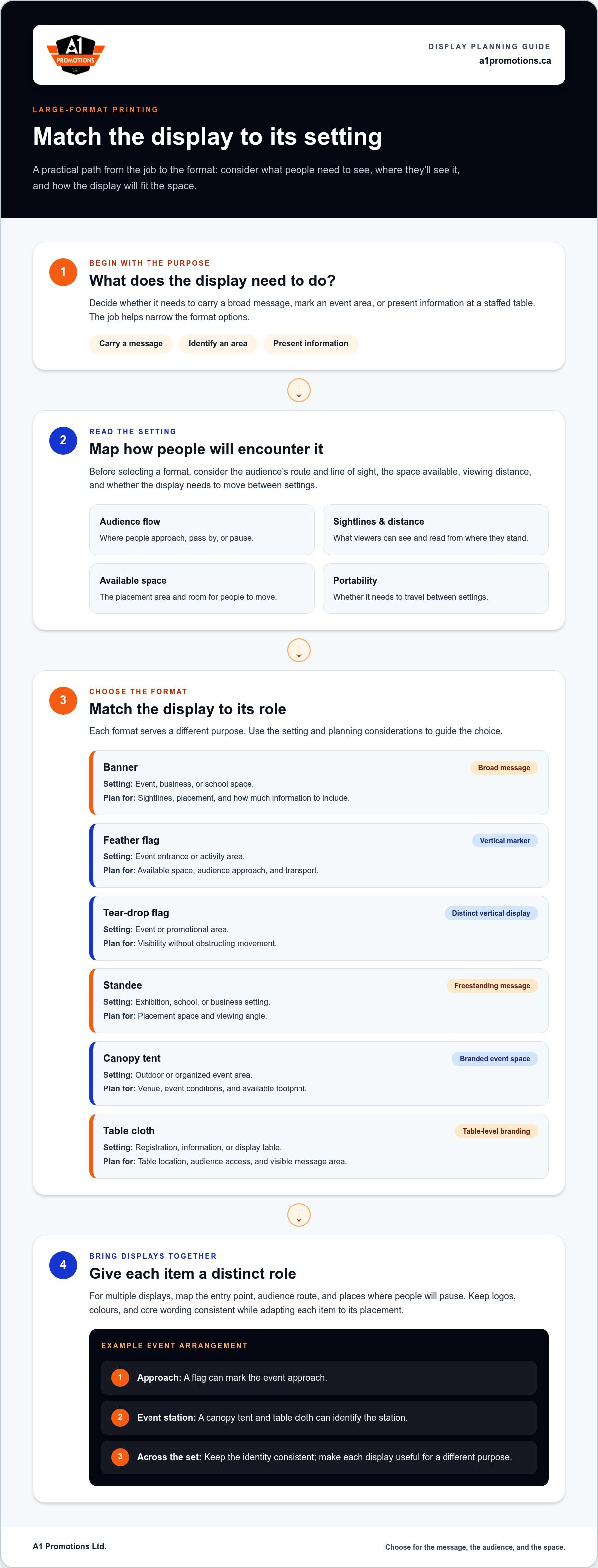
Start with the job the display needs to do. Is it meant to carry a broad message, mark an event area or present information at a staffed table? Then consider audience flow, available space, viewing distance and whether the display needs to move between settings. These questions help narrow the options before you prepare artwork.
| Format | Typical setting | Purpose | Planning considerations |
|---|---|---|---|
| Banner | Event, business or school space | Present a broad message across a visible area | Consider sightlines, placement and the amount of information to include. |
| Feather flag | Event entrance or activity area | Add a vertical visual marker | Check available space, audience approach and how it will be transported. |
| Tear-drop flag | Event or promotional area | Provide a distinct vertical display | Plan its position so it’s visible without obstructing movement. |
| Standee | Exhibition, school or business setting | Present a freestanding message | Allow space for placement and consider the viewing angle. |
| Canopy tent | Outdoor or organized event area | Identify a branded event space | Account for the venue, event conditions and available footprint. |
| Table cloth | Registration, information or display table | Carry branding at table level | Consider table location, audience access and the visible message area. |
When should you choose banners, flags or standees?
A banner works well when a message needs to be read across a broader area. Flags create a vertical visual presence that can help identify an event point or location. A standee suits a message that needs to be presented freestanding rather than attached to a wall or placed on a table. No format is right for every situation. Choose based on the audience’s line of sight, the space available and whether portability is a priority.
For a closer look at banner planning, read this guide to vinyl banners. Plan the format and artwork together so the banner’s message stays easy to understand in its intended setting.
How should event displays work together?
Map the entry point, audience route and places where people will pause before selecting multiple displays. A flag can mark the approach, while a canopy tent and table cloth can identify the event station. Keep logos, colours and core wording consistent, but give each item a distinct purpose so the display set doesn’t feel crowded or repetitive. For coordinated event displays, A1 Promotions Ltd.’s branded display options bring banners, flags, tents and table cloths together with custom branding.
How to prepare artwork for clear large-format printing
Artwork that looks polished on a monitor can become hard to read when enlarged or viewed from across a room. Plan the design around its purpose and viewing distance. Clear artwork starts with a simple message hierarchy, suitable files and a careful final review.
What should artwork communicate first?
Give viewers one main message to notice first, such as an event name, organization or offer. Add a recognizable brand element, then a clear next step if the display needs to prompt an action. Keep supporting details brief and secondary. Strong contrast between text and background, along with an uncluttered layout, helps people take in key information quickly.
Use this checklist to organize the design:
- Set the priority: Identify the single message viewers should remember.
- Add brand recognition: Include the logo or another familiar brand element.
- Include only useful details: Keep supporting copy concise and arrange it by importance.
- Check visibility: Review contrast and text size in relation to expected viewing distance.
- Match the format: Adapt the layout to the shape and placement of the banner, flag, standee or other display.
- Review the proof: Check the final layout before approving production.
Which artwork files and proofing checks matter?
Vector artwork is built from paths and shapes, so it can generally be enlarged without becoming pixelated. Raster artwork is made of pixels, as in photographs. Its suitability depends on image quality and the size at which it will print. A low-resolution image may look acceptable on a small screen but appear soft at display scale. There isn’t one resolution requirement for every project; viewing distance and the selected product affect what’s appropriate.
File requirements also depend on the display and production setup. Share the intended format and final dimensions as part of the project details, and prepare files to suit those requirements. Colour settings and file type can affect how artwork reproduces, so don’t assume one setup applies to every print.
Before approval, inspect the proof at a useful size and check:
- Spelling, contact details and other text.
- Logo placement, colour consistency and contrast.
- Image quality, cropping and alignment.
- Layout and final dimensions for the chosen display.
A proof gives you the opportunity to catch errors while the artwork can still be adjusted. Review it against the original brief, not just for appearance. Confirm that the main message is prominent and every detail is correct before approving production.
What to expect from a large-format printing project workflow
A clear process keeps the display, artwork and project requirements aligned from the first discussion through production. Each step builds on the decisions made before it: the brief guides format selection, the format shapes artwork requirements, and approval confirms the design before production begins.
- 1. Prepare the brief: Outline the display’s purpose, audience, setting and main message. Note the brand assets and products needed.
- 2. Select the format: Choose display types to suit the space and audience, such as banners, flags, standees, canopy tents or table cloths.
- 3. Review the artwork: Check the supplied files and layout against the chosen format, message and brand direction.
- 4. Approve the final design: Review the proof and communicate any corrections before giving approval.
- 5. Move to production: Production follows approval of the final design.
What information belongs in a print project brief?
A useful brief gives everyone involved a shared reference point. Include the intended use, audience, display setting, key message and relevant brand assets, such as a logo and colour references. List the products required, too. If a banner, flags and table cloth need to appear together, explain how they’ll be used as a set and which message or brand elements should carry across them.
Specific context helps guide practical decisions. A display for an entrance may need to communicate a name or direction at a glance, while a staffed event area may need coordinated branding across several items. A1 Promotions offers friendly advice and dedicated support to help organize project details and branded materials.
How do artwork review and production approvals fit?
Artwork review checks whether the supplied design suits the selected display and whether its key elements are ready to reproduce. Review the layout, spelling, colour choices, logo placement and image quality. Compare the design with the brief to make sure details such as the main message and intended audience haven’t been lost during preparation.
Approval is the decision point. Check the final proof carefully, collect any required internal feedback and identify corrections clearly. Once you approve the final design, it moves to production. An organized review helps reduce avoidable errors and keeps the finished work aligned with the approved artwork.
Have a display brief ready? Discuss a branded display project with A1 Promotions.
Plan coordinated large-format printing with A1 Promotions
A display can establish a visual identity, while coordinated branded items help carry that identity beyond one location. A1 Promotions Ltd. is a family-owned business serving customers since 2004, with expert decoration and a one-stop shop for displays, apparel, awards and promotional merchandise. Its tagline says it simply: “Quality branded merchandise that gets noticed”.
How can one partner coordinate displays and branded merchandise?
Start with a consistent set of brand elements: logo, colours, type styles and core message. Apply them across banners and flags, then carry the same visual direction into apparel and event merchandise. For example, a canopy tent and table cloth can identify an event space, while branded shirts and promotional items help staff and attendees recognize the organisation. Each piece serves a different purpose, but consistent branding makes them feel connected.
Working with one partner for displays and related items can help keep project details aligned. A1 Promotions Ltd. brings custom branding and expert decoration together across tents, flags, apparel, awards and promotional products. For ideas on extending a consistent identity across merchandise, see the Promotional Products Canada branding guide.
What should you prepare before requesting project support?
A clear starting brief helps turn a general idea into a coordinated project. Gather the intended use, audience, setting and key message. Note which display formats you’re considering and what other branded items should accompany them. If items will be used together at an event, describe where each will appear and how they should connect visually.
Bring existing brand materials where possible. A logo, brand colour references and draft artwork give the project team useful direction. Include any wording that must appear, and identify the main message viewers should notice first. These details help guide friendly advice and dedicated support from planning through artwork review.
Ready to plan a branded display and merchandise together? Start a conversation with A1 Promotions Ltd. about your project for large format printing Surrey.
Put your display plan into action
A successful large-format print project begins with its purpose and setting. Choose a banner, flag, tent or standee to suit the audience and available space, then prepare concise artwork with a clear message, readable contrast and carefully reviewed details. A project brief and approval of the final design help keep the process organized from format selection through production.
A1 Promotions can bring display items and related branded merchandise together. The family-owned and operated business has served customers since 2004 and offers a one-stop shop for apparel, awards, promotional items, tents and flags. Coordinating these materials can help create a consistent brand presence across an event or campaign.
Have a project in mind? Discuss your large-format printing project with A1 Promotions and take the next step towards a clear, coordinated display.
Frequently Asked Questions
What is large-format printing?
Large-format printing produces oversized graphics for display in spaces, at events and in promotions. The format makes text and visuals visible across a distance or within a larger setting. A project may use one display or several coordinated pieces. The message, audience, placement and viewing distance help determine how to organize the design and which format will serve its purpose.
What products are considered large-format prints?
Large-format prints include oversized visual displays such as banners, flags and other event graphics. A1 Promotions’ display offerings include banners, feather flags, tear-drop flags, standees, canopy tents and table cloths. Banners can carry a broad message, flags provide a vertical display, standees present information freestanding, and tents or table cloths can help create a coordinated event space. The intended setting helps determine which format fits.
How do I choose the right format for a large-format printing project?
Choose a format based on the display’s purpose, setting, audience and viewing distance. Consider where people will approach from, how much display space is available and whether the piece needs to move between settings. First define the message and intended use, then compare banners, flags, standees, canopy tents and table cloths against those needs.
What file format should I use for large-format printing?
Vector files such as AI, EPS and PDF are generally preferred because vector graphics can be enlarged without losing sharpness. Raster images, such as TIFF or JPG files, are made of pixels, so image quality depends on resolution, finished size and viewing distance. File requirements vary with the selected product and production setup. Share the intended format and final dimensions when preparing artwork.
How can I make a large-format banner easy to read?
Give the banner one main message and make it the most prominent element. Use concise wording, clear contrast between text and background, and an uncluttered layout. Include only supporting details that viewers need, such as an organization name or next step. Consider the distance from which people will read it, then review the artwork at a scale that helps you judge whether the important information stands out quickly.
What affects the cost of large-format printing?
Project cost can depend on factors such as the selected display format, its dimensions, the material and the complexity of the artwork. Multiple display types or coordinated branded pieces can also affect the scope of a project. To support a clear discussion, prepare the intended use, setting, required formats, brand assets and draft artwork. A1 Promotions provides custom branding for displays and related merchandise. Discuss your project with A1 Promotions.


