Is a standard 13 oz banner durable enough to survive a typical British Columbia windstorm? Many business owners in Surrey assume all vinyl banners are created equal until they see their investment tattered after a single season. It's a common frustration to deal with ripping grommets or blurry graphics when you simply need a professional result for your event or storefront.
We understand that selecting the right signage requires technical precision. You need to know if a heavy scrim vinyl or a breathable mesh is the correct choice for your specific environment. This guide provides the clarity required to select, design, and maintain your banners so they remain intact and effective regardless of the weather.
You will learn the differences between material weights, how to prepare high-resolution files for large format printing, and the best practices for secure installation. We also outline how to find a reliable local partner to ensure your branding meets professional standards.
Key Takeaways
- Identify the correct material weight using the "oz" rating system to ensure your vinyl banners withstand local environmental pressures.
- Implement the "3-second rule" in your layout to guarantee high-impact communication for passing traffic.
- Evaluate the technical differences between matte and glossy finishes to optimize visibility under various lighting conditions.
- Master secure installation techniques using reinforced hems and grommets to prevent edge curl and material failure.
- Recognize the efficiency of local Surrey production for faster turnaround times and integrated brand management across your promotional assets.
What are Vinyl Banners? Understanding the Essentials
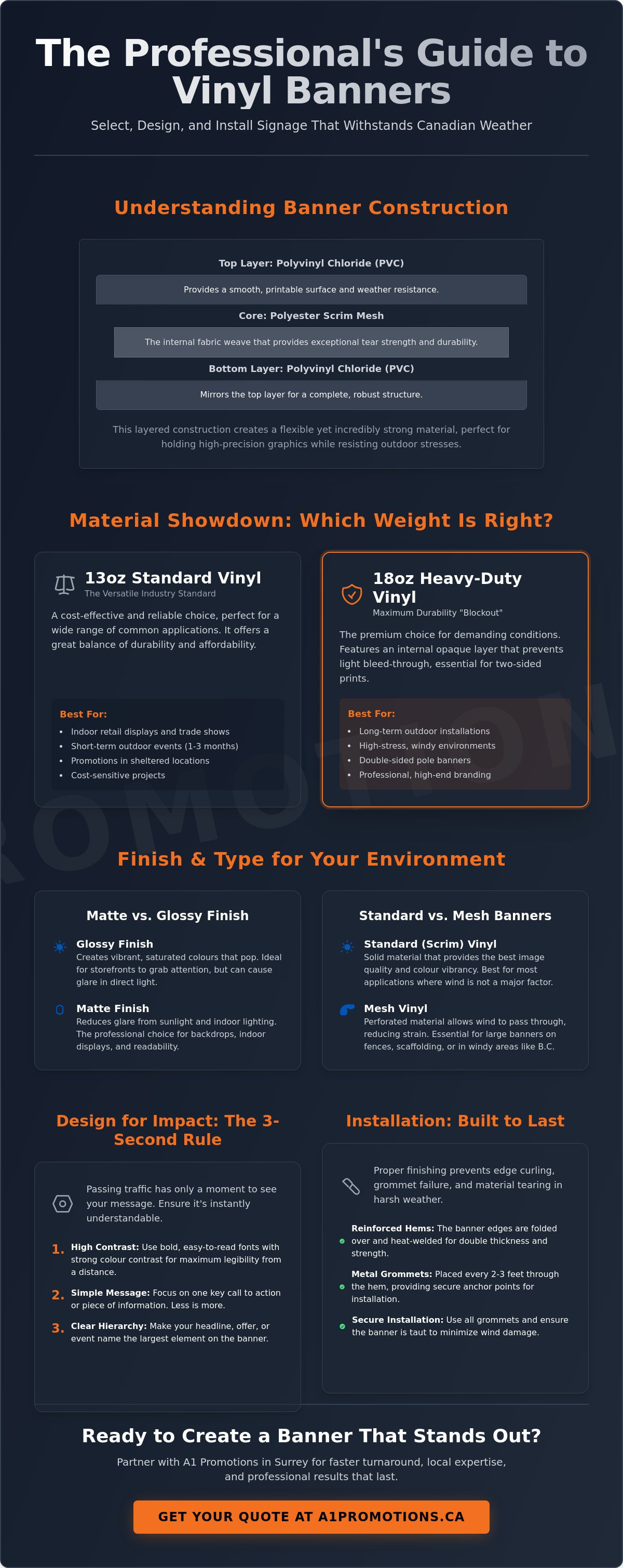
Vinyl banners are the primary choice for large-format signage due to their specific chemical composition. These displays consist of a polyester mesh, known as a scrim, embedded between two layers of polyvinyl chloride (PVC). This construction creates a material that is both flexible and exceptionally strong. To get a full technical overview of the manufacturing process, you can research What are Vinyl Banners? through industry archives. The result is a substrate that holds ink with high precision while resisting the physical stresses of outdoor installation. Every banner comprises three core components: the base fabric for strength, the laminate for ink receptivity, and a finish that determines the final look.
Why Choose Vinyl Over Other Signage Materials?
Choosing the right material depends on your specific environment and budget. Paper signs lack the durability for anything beyond short-term indoor use. Fabric banners offer a premium aesthetic but often command a higher price point and lack the same level of moisture resistance. vinyl banners provide a balanced solution. They offer weatherproofing against UV rays and rain, which is a necessity in the Lower Mainland. It is a practical choice for organizations that need a reliable display that doesn't require constant replacement.
This material acts as a silent partner for your marketing efforts. It provides constant brand visibility without the recurring costs associated with digital advertising or print media. Once installed, a high-quality banner functions as a durable asset that maintains its colour profile for years. The cost-to-longevity ratio makes it one of the most efficient investments for local business branding in BC.
Common Applications for Local Organizations
The versatility of PVC signage allows it to serve multiple sectors within the Surrey community. Local retail centres utilize these banners for grand openings and seasonal sales to capture the attention of passing motorists. The matte or glossy finish options ensure that graphics remain legible under varying light conditions. If you're coordinating a school event or managing a commercial storefront, the material's adaptability ensures it meets the specific requirements of the project.
Educational institutions and sports teams also rely on this format for high-visibility communication. Common uses include:
- School spirit days and graduation ceremonies.
- Local sports tournaments and field branding.
- Temporary construction site safety information and hoarding.
- Directional signage for large outdoor community festivals.
Because vinyl banners are easy to transport and store, they're often reused for annual events. This repeatability further increases the value of the initial purchase for local non-profits and community groups.
Decoding Banner Materials: Scrim, Mesh, and Weights
The durability of vinyl banners is determined by two primary technical specifications: weight and denier. Weight is measured in ounces (oz) per square yard. This rating indicates the thickness of the material and its ability to withstand physical stress. Denier refers to the density of the internal polyester scrim. A higher denier count signifies a stronger internal weave, which prevents the banner from stretching, sagging, or tearing under tension. Selecting the correct material requires a balance between the intended duration of use and the specific environmental conditions of the installation site.
Lighting conditions also influence material selection through the choice of matte or glossy finishes. A matte finish is designed to reduce glare from direct sunlight or artificial stage lighting. It's the functional choice for media backdrops and indoor trade show displays. Glossy finishes provide higher colour saturation and contrast. This makes them ideal for retail storefronts where high-impact visuals are necessary to capture the attention of passing traffic. For a deeper technical comparison of these substrates, Decoding Banner Materials provides an analysis of how different surfaces perform in various climates.
13Oz vs. 18oz Vinyl: Which Weight is Right?
The 13oz vinyl is the industry standard for most general applications. It's cost-effective and performs well for indoor signage or short-term outdoor promotions in sheltered locations. However, 18oz vinyl is the heavy-duty alternative. This "blockout" material features an internal opaque layer that prevents light from shining through. It's required for double-sided printing and high-stress outdoor environments. You must realize that using a lighter material for a long-term outdoor project often results in grommet failure or premature tearing. If you're planning a large-scale project, you can browse our material specifications to ensure your signage meets professional standards.
Mesh Banners for High-Wind Environments
Standard vinyl banners act like sails when exposed to heavy wind. This creates immense pressure on the mounting points and the structure holding the sign. Mesh banners address this issue with a perforated design that allows approximately 30 percent airflow to pass through the material. This makes them the optimal choice for fence wraps, scaffolding, and large festivals across BC. While mesh provides superior structural integrity in wind, there's a trade-off in visual density. The perforations make the graphics appear slightly less vibrant compared to solid scrim vinyl. This material is best suited for large-scale graphics where the viewer is positioned at a significant distance.
Choosing the right material ensures your investment lasts for its intended lifespan. Whether you need the portability of a 13oz scrim or the wind-resistance of a mesh wrap, matching the technical specs to the location is the first step in a successful campaign.
Designing Your Banner for Maximum Visual Impact
Large-format design requires a different technical approach than digital or standard print media. Most viewers process your message while moving in a vehicle or walking past a storefront. This reality necessitates the "3-second rule." Your primary message must be legible and understood within three seconds. Simplicity is the requirement for success. Avoid crowding the layout with excessive text or multiple competing images. Strategic use of whitespace organizes the information, allowing the eye to focus on the call to action immediately.
Technical precision in file preparation is non-negotiable for vinyl banners. Scaling a low-resolution web image for a six-foot display results in severe pixelation. Always use high-resolution vector graphics in formats such as AI, EPS, or print-ready PDF. This ensures your logo and text remain sharp at any size. Colour management is equally critical. Ensure your design files use the CMYK colour profile to maintain brand consistency between your digital proofs and the final printed substrate. Matching these colours across different promotional assets, like your custom headwear or stationery, keeps your brand identity unified.
Typography and Contrast for Distance Reading
Legibility at a distance depends on font selection and colour contrast. Bold, sans-serif fonts are the industry standard for vinyl banners because they remain clear from 50 feet or more. Avoid script or highly decorative fonts. These styles often blur together when viewed from the street. High-contrast pairings provide the best visibility. Consider these combinations:
- Black text on a yellow background.
- White text on a dark blue or black background.
- Dark green text on a white background.
Thin lines and light colours often disappear against the sky or urban backgrounds. Stick to heavy weights and saturated tones to ensure your message stands out in the Surrey landscape.
Sizing Your Banner for the Location
Measure your installation site accurately before finalizing your order. A banner that is too small looks like an afterthought, while one that is too large will sag and catch the wind. Standard sizes like 3x6 feet or 4x8 feet are common, but custom-cut dimensions allow for a perfect fit on specific railings or building faces. You must also account for the "safety zone." Keep all critical text and logos at least two inches away from the edges. This prevents your content from being obscured or cut off by grommets and reinforced hems during the finishing process.
Planning your design with these technical constraints ensures a professional result. It moves the project from a simple sign to a strategic branding asset that delivers clear communication to your target audience.
Installation and Maintenance in the Canadian Climate
Proper installation determines whether your vinyl banners survive a single season or remain a multi-year asset. The most common point of failure isn't the material itself but the mounting hardware. Reinforced hems are essential to prevent edge curl and provide a structural anchor for grommets. Without this reinforcement, the tension from zip ties or bungee cords can cause the metal rings to pull through the PVC layer during high-stress events. Safety is a primary consideration when hanging large displays over public walkways. Ensure all mounting points are rated for the banner's weight and potential wind load.
Maintenance is straightforward but requires consistency. Cleaning involves only a mild detergent and water. Avoid abrasive chemicals that can strip the protective laminate or damage the ink. Storage is equally critical. Never fold your banner. Folding creates permanent creases that compromise the visual quality and material integrity. Roll the banner with the graphics facing outward. Ensure it's completely dry before storage to prevent mould growth. If you require assistance with hardware selection, you can order professional mounting accessories to secure your signage.
Weatherproofing for the Lower Mainland
Signage in the Lower Mainland faces specific environmental challenges. High humidity and sudden wind gusts create a "sail effect" that can destabilize standard mounts. UV exposure, even on overcast days, eventually degrades standard inks. Using UV-resistant inks and choosing a matte finish can mitigate fading and glare. For horizontal installations, ensure a slight angle to allow for proper rain drainage. Water pooling adds unnecessary weight and stress to the fabric, leading to premature sagging.
Step-by-Step Installation Guide
Follow this protocol to ensure a professional and secure fit for your display:
- Step 1: Inspect the mounting surface for sharp edges, protrusions, or abrasive textures that could puncture the vinyl.
- Step 2: Secure the top corners first. Work outward from the centre to maintain consistent tension across the top edge.
- Step 3: Use bungee cords instead of rigid zip ties for outdoor setups. Bungees allow for slight "give" during high winds, reducing the shock load on grommets.
- Step 4: Perform a final tension check. Eliminate wrinkles and sagging to ensure the graphics remain legible and professional.
Correct tensioning prevents the material from flapping. Constant movement against a wall or post acts like sandpaper, slowly eroding the print and weakening the scrim. A drum-tight installation is the best defence against the Canadian elements.
Why Local Expertise Matters for Your Signage Projects
Local production in Surrey eliminates the logistical complexities associated with international shipping. A1 Promotions Ltd. provides a streamlined experience where you don't have to account for cross-border delays or unexpected brokerage fees. This proximity allows for a faster turnaround when project deadlines are tight. A local partner understands the specific venue requirements for Surrey parks, community centres, and commercial zones. This insight ensures your material selection matches the environmental demands of the Lower Mainland. You get direct access to technical advice that considers local wind loads and weather patterns.
Integrated branding requires consistency across every medium. A1 Promotions Ltd. ensures your vinyl banners match your other promotional assets with high precision. For instance, the colour profile on your signage should align perfectly with your custom printed t-shirts. This holistic approach prevents brand fragmentation and ensures a professional appearance at every touchpoint. It's a level of coordination that generic online retailers cannot provide. Working with a local facilitator allows you to verify material quality and colour accuracy before the final production run.
A1 Promotions Ltd.: Your Branding Partner Since 2004
A1 Promotions Ltd. has operated as a family-run business for two decades. We prioritize functional directness and transparent quality. Our expertise extends beyond large-format printing. We facilitate comprehensive recognition programs by providing trophies and medals alongside our apparel and signage offerings. This diverse inventory makes us a single-source partner for schools, sports teams, and corporate organizations in BC. Our no-nonsense approach to pricing and quality builds long-term trust. We focus on providing the tools you need for branding without unnecessary distractions.
Getting Started with Your Banner Project
The process begins with a technical consultation to determine your specific material needs. Whether you require high-wind mesh for a construction site or heavy-duty blockout vinyl for a double-sided storefront display, we guide you through the selection. We analyze your installation site to recommend the correct grommet placement and finishing options. Our wide-format printing capabilities ensure your vision is realized with professional clarity. High-resolution vector files are processed through our systems to maintain sharp edges and vibrant colours. Are you ready to organize your next event with durable vinyl banners? Contact A1 Promotions Ltd. for a custom vinyl banner quote today.
Secure Your Brand Presence with Professional Signage
Selecting the right substrate and finalizing a high-impact design are the first steps toward effective outdoor communication. You've learned how material weights like 18oz blockout vinyl or breathable mesh protect your investment against the specific environmental pressures of British Columbia. Proper installation using reinforced hems and bungee cords ensures your display remains professional and secure throughout the year.
A1 Promotions Ltd. has served as a family-run Surrey business since 2004. We provide high-quality wide-format printing with the fast turnaround times required for Lower Mainland projects. Our team integrates your vinyl banners with your existing promotional assets to ensure a unified brand identity across all platforms. This coordinated approach eliminates the logistical friction of dealing with multiple distant suppliers. We prioritize transparency and functional directness in every transaction.
Request a Quote for Custom Vinyl Banners. We look forward to facilitating your next branding project with reliability and technical precision.
Frequently Asked Questions
How long do vinyl banners typically last outdoors in Canada?
Outdoor vinyl banners typically last between 2 and 5 years in the Canadian climate. This duration depends on the material weight and the level of direct UV exposure. Using an 18oz blockout vinyl often provides better resistance to physical degradation than a standard 13oz option. Constant exposure to high winds in coastal BC areas may reduce this lifespan if the banner isn't secured with bungee cords to absorb tension.
Can I use a vinyl banner in freezing temperatures during BC winters?
Vinyl banners remain functional in freezing temperatures, but the PVC substrate becomes brittle in sub-zero conditions. You must avoid folding or flexing the material when it's frozen to prevent the surface from cracking. If you need to relocate a banner during a BC winter, allow the material to warm to room temperature before rolling it for storage. This preserves the integrity of both the scrim and the printed ink layer.
What is the best way to remove wrinkles from a vinyl banner?
The most efficient method for removing wrinkles is to hang the banner taut in a warm environment or direct sunlight. The heat allows the vinyl to relax and return to its original flat state. You can also use a hair dryer on a low heat setting, but keep the device moving to avoid melting the laminate. Don't use a traditional clothing iron directly on the vinyl surface, as this will cause permanent damage.
Do I need a permit to hang a vinyl banner in Surrey, BC?
Surrey's municipal bylaws typically require a sign permit for any banner displayed on a commercial storefront or public property. The City of Surrey classifies vinyl banners as temporary signage, and specific restrictions apply to their size and the duration they can remain in place. It's best to verify current regulations with the local planning department before installation to ensure your project remains compliant with regional branding standards.
What is the difference between single-sided and double-sided banners?
Single-sided banners are printed on one surface and are ideal for wall mounts or fences. Double-sided banners utilize a specific 18oz blockout material that features an internal opaque layer. This construction prevents light from shining through, ensuring that the graphics on both sides remain clear and legible. You'll need this option for street-spanning displays or any installation where the back of the banner is visible to the public.
How do I clean a banner that has been exposed to road salt or grime?
Remove road salt and environmental grime using a soft cloth and a solution of mild dish soap and warm water. It's essential to avoid abrasive sponges or solvent-based cleaners, as these can strip the protective UV coating and degrade the ink. Rinse the surface thoroughly with clean water and ensure the banner is completely dry before rolling it up. This prevents the growth of mould during storage.
Can vinyl banners be recycled after their use is finished?
Standard PVC banners are difficult to recycle through traditional curbside programs because they combine polyester mesh with vinyl. Most municipal facilities in BC don't accept these materials. However, some specialized industrial recycling programs can process the material for secondary uses like tool bags or mats. If your banner has reached the end of its life, check with local industrial waste processors for specialized repurposing options.
What file format is best for printing a large vinyl banner?
Vector-based PDF, EPS, or AI files are the optimal formats for high-quality banner printing. These formats allow for infinite scaling without the loss of detail or the introduction of pixelation. If you must use a raster image, ensure it has a resolution of at least 150 DPI at the final print size. Providing files in the CMYK colour profile ensures that the finished product matches your intended brand colours accurately.


