
For organizations planning custom screen printing projects, the garment, artwork and intended use matter as much as the logo itself. It is natural to wonder whether fine details, colours or placement will look different on a finished T-shirt than they do on screen.
A clear project brief helps set expectations. This guide explains the screen-printing process, what can affect how artwork reproduces and how to match apparel to its audience and purpose. It also covers what to prepare for a focused project discussion, including artwork files, colour preferences, print placement and garment use. A1 Promotions Ltd. has served customers across Canada since 2004, with screen-printed T-shirts as its primary service. Planning these details helps your organisation make informed choices about branded apparel.
Key Takeaways
- Understand the steps that turn artwork into a screen-printed T-shirt, from screen preparation to curing.
- Review colours, placement and fine details before production to set clear expectations for the finished design.
- Choose apparel with its audience and use in mind, whether it’s for staff, a team, a school or an event.
- Prepare a brief with your artwork, apparel category, colour preferences, placement and audience details.
- Organizations across Canada can work with A1 Promotions Ltd., a family-run business serving customers since 2004.
How custom screen printing turns artwork into branded apparel
Screen printing transfers a design onto apparel by pushing ink through the open areas of a prepared mesh screen. Blocked areas stop the ink from passing through, leaving the intended image on the garment. The result depends on the artwork, garment, colours, placement and project requirements. Understanding the process helps organizations see what happens between submitting a design and producing branded apparel.
What happens during the screen-printing process?
The stages are easiest to understand in order. Each prepares the design or garment for the next.
- Prepare the artwork. The design is reviewed for colour, shape, detail and intended print size. Clear artwork helps establish how the image can be represented on a screen.
- Create the screen. A mesh screen is prepared with a stencil. The stencil blocks areas that should remain unprinted and leaves the design areas open for ink.
- Apply the ink. The screen is positioned over the garment, and ink is drawn across it through the open parts of the mesh. Careful positioning transfers the design to the intended area.
- Cure the print. The printed garment is treated so the ink sets. The curing approach depends on the materials and production requirements.
For a design with multiple colours, the artwork must account for the placement and alignment of each colour. A useful overview of the history and process of screen printing explains the method’s wider techniques and applications. For your project, share the intended garment and design together so they can be considered as one decision.
Where does custom screen-printed apparel fit?
T-shirts work well for staff clothing, events and group identity. Depending on the project, apparel planning may also include hoodies, corporate clothing, restaurant apparel or sports team apparel. Each setting has different priorities: staff may need a consistent, recognizable look, a team may want to emphasize shared identity, and an event organizer may focus on visibility and audience fit. Screen-printed T-shirts are A1 Promotions Ltd.’s primary service, supported by expert decoration and friendly project advice.
Think about where people will wear the garment. Restaurant apparel should suit the work setting and brand presentation. Sports team clothing should make the team easy to recognize. Event apparel can help staff stand out or give participants a shared marker of attendance. These needs can guide garment choice, design size and placement.
For help assessing garment quality and making informed choices, see the custom printed T-shirts quality guide. Starting with the intended use gives the artwork and apparel a clear purpose and makes the project discussion more focused.
Prepare screen-printing artwork for clear, intentional results
A useful artwork brief connects the design to the garment it will appear on. Before sharing files, settle on the final design version, print location, garment type and colour preferences. This gives the project team a clear basis for discussing how the artwork may translate to apparel. For organisations searching for custom screen printing Surrey, these details provide a practical starting point.
Use this checklist to organise the essentials:
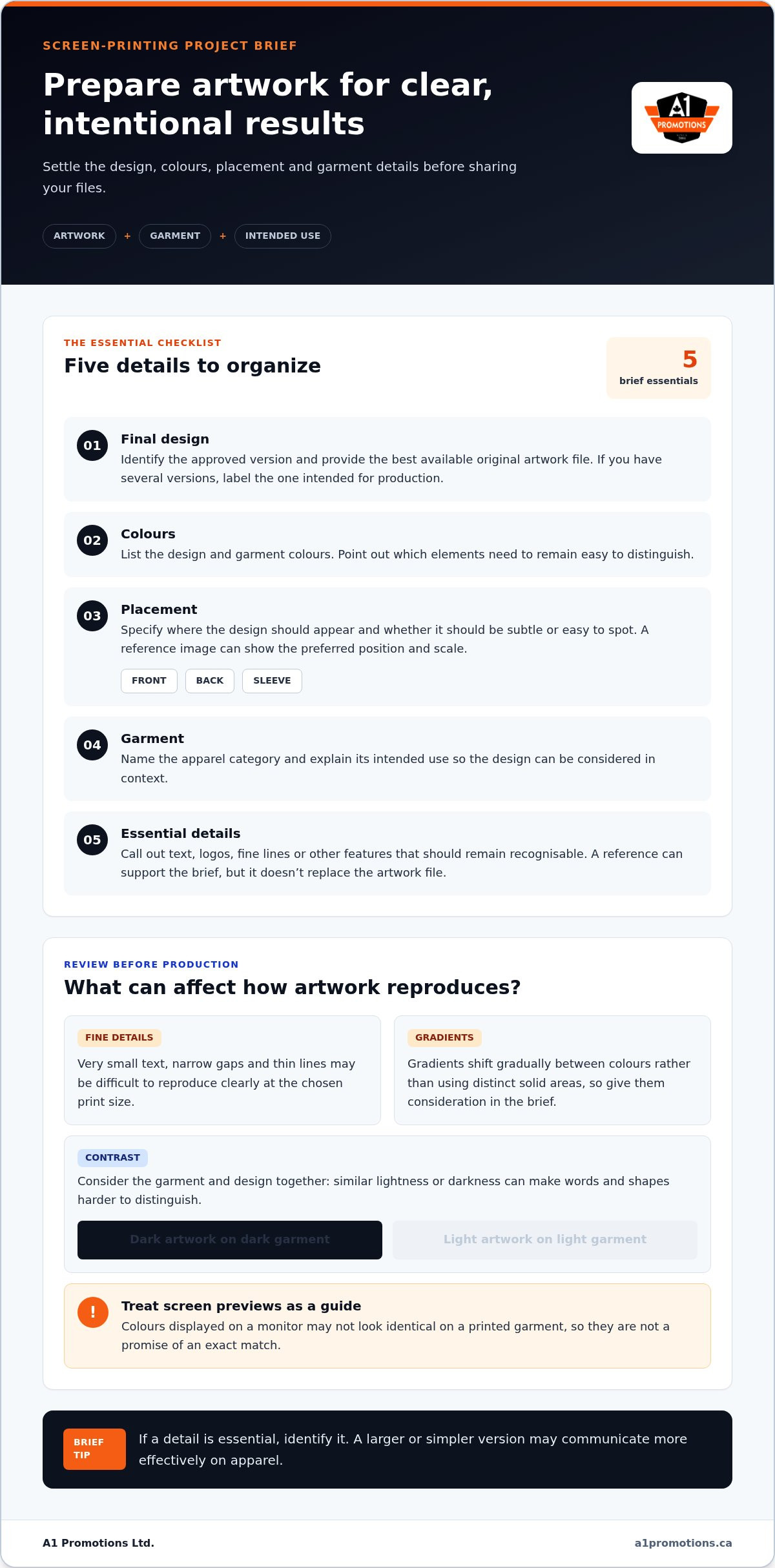
- Final design: Identify the approved version and provide the best available original artwork file. If you have several versions, label the one intended for production.
- Colours: List the design and garment colours. Point out which elements need to remain easy to distinguish.
- Placement: Specify where the design should appear, such as the front, back or sleeve. A reference image can help show the preferred position and scale.
- Garment: Name the apparel category and explain its intended use so the design can be considered in context.
- Essential details: Call out text, logos, fine lines or other features that should remain recognisable.
Which artwork details should the brief include?
State the final design version, intended print location and garment type plainly. Add notes about text, logos, colours and elements that must remain intact. If you have a visual reference, explain what it shows, such as layout or relative size. A reference can support the brief, but it doesn’t replace the artwork file.
Review fine details closely. Very small text, narrow gaps and thin lines may be difficult to reproduce clearly at the chosen print size. Gradients also need consideration because they shift gradually between colours instead of using distinct solid areas. If a detail is essential, identify it rather than assuming it will stand out once printed. A larger or simpler version may communicate more effectively on apparel.
How can colour and placement choices affect the design?
Contrast affects legibility. Dark artwork on a dark garment, or light artwork on a light one, can make words and shapes harder to distinguish. Consider the garment and design together, and identify any colour relationships that matter to your organisation. Colours displayed on a monitor may not look identical on a printed garment, so treat screen previews as a guide, not a promise of an exact match.
Placement affects visibility and balance. A small logo in one area serves a different purpose from a large central graphic; either should suit the audience and how the apparel will be worn. A reference can show the preferred position, while a note about prominence clarifies whether the design should be subtle or easy to spot.
Clear files and specific notes make for a more focused design discussion. A1 Promotions Ltd. provides expert decoration and friendly advice for branded apparel projects. If you’re preparing screen-printed T-shirts, you can discuss your artwork and apparel project with A1 Promotions Ltd..
Match screen-printed apparel to its audience and intended use
Start with who will wear the apparel and where they’ll wear it. An event garment may prioritize easy recognition, while workplace clothing should support a consistent, identifiable presentation. Comfort matters too: consider how long people will wear the item, what they’ll be doing and what feels appropriate for the group. These details help narrow garment and design choices before the artwork is finalized.
| Project context | Apparel category to consider | Questions to ask |
|---|---|---|
| Staff or corporate clothing | T-shirts or workplace apparel | Should the logo be easy to spot during daily interactions? What level of formality suits the workplace? |
| Restaurant team | T-shirts or other restaurant apparel | Will the garment suit the work setting and support a consistent team appearance? |
| Sports team or club | T-shirts, hoodies or coordinated group apparel | Does the design make the group identity clear at practices, gatherings or events? |
| School or student group | T-shirts, hoodies or school apparel | Will the design appeal to the intended age group and make names or logos readable? |
| Event audience | T-shirts or casual group apparel | Will people wear it during the event, afterwards, or both? Does the design suit participants, staff or organizers? |
Which apparel category suits the project?
T-shirts suit group apparel, events and casual brand visibility. Hoodies may be a fit when the project calls for a warmer, more substantial layer. For corporate and restaurant settings, prioritize a garment that fits the workplace and makes staff identifiable. Team, club and school apparel can reinforce a shared identity, particularly when the design is consistent across the group. Choose based on audience, setting and purpose, not just the logo.
What should the design and garment work well together?
Assess the garment colour alongside the design. Strong contrast can help a logo or text stand out, while colours with little distinction may make important details harder to see. Consider viewing distance, too. A small chest logo may suit close conversations, while event apparel seen across a room may call for a more prominent graphic. Keep essential wording concise and readable at the intended size.
Placement should suit both the garment and its use. A design meant to identify staff should be visible during normal interactions; a club graphic may put more emphasis on shared identity. Consider how people will wear and move in the apparel, and whether the chosen location will remain visible in that context.
For broader decisions across apparel types, the custom clothing in Canada guide can help frame garment choices as part of a wider branded-apparel plan. A1 Promotions offers screen-printed T-shirts and other branded apparel for organizations planning coordinated clothing.
Plan a custom screen-printing project with a clear brief
A clear brief connects the purpose of the apparel with the artwork, garment and schedule. It also gives A1 Promotions useful context for providing friendly project advice and expert decoration. Whether you’re organizing staff clothing, team apparel or event T-shirts, gather the key decisions in one place before reviewing the proposed design.
What information belongs in a useful project brief?
Start with the project purpose and audience. Note how and where people will wear the apparel, which garment category you have in mind, and when you need the finished items. Include the best available artwork, preferred garment colours, print placement and any visual references. For a custom screen printing Surrey project, clear details make the initial discussion more focused.
- Define the purpose. Explain what the apparel is for, such as identifying staff, bringing a club together or supporting an event.
- Describe the audience and use. Consider who will wear the garments, the setting and how often they’re expected to be worn. These details can help guide garment selection.
- Choose an apparel category. Identify whether you’re considering T-shirts, hoodies or another suitable category. If you’re open to options, say so.
- Gather design details. Provide the final artwork version, garment colour preferences, intended print location and references that show the look you have in mind. Flag important text, logos or visual elements.
- Set a realistic schedule. Share the date you need the items and work backwards to identify when decisions need to be made. Leave room for discussion, artwork review and approval without assuming a particular turnaround.
How should the design be reviewed before production?
Review the artwork as it will appear on the chosen garment, not as a separate file. Check spelling, logo placement, colour choices and the balance of the layout. Consider whether text will be readable at its intended size and whether the design suits the group’s identity and expectations. Treat screen previews as a visual guide, since colours may look different on a monitor than on printed apparel.
Before approving the design, compare it with the brief. Does it fit the audience? Is the placement appropriate for how the garment will be worn? Are the organization’s name and other essential details correct? Reviewing these points together helps keep project decisions consistent.
Once your brief is ready, explore custom apparel options and discuss how screen-printed T-shirts can fit your organization’s needs with A1 Promotions.
Bring your project details together and start a custom apparel discussion with A1 Promotions.
Work with A1 Promotions on custom screen printing
A1 Promotions is a family-run business serving customers since 2004. Screen-printed T-shirts are its primary service, supporting businesses, schools, sports teams, clubs, restaurants and other organizations planning branded apparel. For organizations searching for custom screen printing Surrey, a practical starting point is to connect the artwork with the garment, audience and purpose.
What does A1 Promotions bring to a branded-apparel project?
A1 Promotions’ experience in sportswear and promotional products supports organizations with branding needs. Premium-quality sourcing and expert decoration are central to its offering, alongside friendly advice and dedicated support. This is useful when the logo, garment choice and intended use need to work together rather than being treated as separate details.
For a project centred on screen-printed T-shirts, bring the design and intended use into the discussion. A staff shirt, club garment and event T-shirt may each call for a different balance of visibility, audience appeal and everyday wear. Sharing those priorities gives the project discussion useful context. If the brief includes more than apparel, A1 Promotions also offers promotional items, awards, tents and flags, bringing these branded products together under one roof.
What is the next step for custom screen printing?
Gather the information that will shape the project: your artwork, preferred garment category and colours, where the design should appear, and what the apparel is for. Include priorities such as logo prominence or text that must remain readable. A clear starting brief keeps your organization’s needs in view and makes the discussion more specific.
A1 Promotions supports projects with expert decoration, friendly advice and dedicated service. Share the intended audience and setting along with the visual direction, so these elements can be considered together.
Quality branded merchandise that gets noticed
Ready to discuss your artwork, garment preferences and project purpose? Discuss your custom screen-printing project with A1 Promotions.
Turn your apparel idea into a clear next step
Start by identifying what you want the apparel to do for your organization. Should it help people recognize staff, create a sense of belonging or keep your brand visible beyond an event? Choosing a priority gives the design discussion a useful focus and helps keep decisions aligned as the project takes shape.
If you’re considering custom screen printing Surrey organizations can use, bring that goal, your artwork and garment preferences into the conversation. A1 Promotions supports projects with premium-quality sourcing, expert decoration and friendly advice. Apparel can also sit alongside awards, promotional items, tents and flags for broader branding needs.
When you’re ready to shape the brief and explore options, discuss your custom screen-printing project with A1 Promotions. A clear purpose is a solid starting point for moving your idea forward.
Frequently Asked Questions
How should I wash a screen-printed T-shirt?
Follow the garment’s care label first, since washing guidance can vary by apparel. A cautious routine is to turn the shirt inside out and use a gentle wash cycle. Avoid bleach unless the care instructions permit it. Check the label before using a hot dryer, as high heat can be hard on garments and printed designs. Washing a new shirt separately the first time can also help avoid colour transfer.
Can screen printing reproduce a photographic image?
It can reproduce photographic-style artwork in some cases, but the image usually needs to be adapted for printing rather than copied directly from a photo file. Screen printing represents tones using areas of colour and, in some approaches, patterns of dots. Detail, image size and contrast all affect clarity. A cropped, high-contrast version may communicate better on a T-shirt than a busy photograph with subtle shadows.
Does screen printing work for designs with gradients?
Gradients can be adapted for screen printing, but smooth transitions may need to be converted into halftones, a pattern of dots that suggests changes in tone. The result depends on the artwork and the size of the printed design. Before finalizing a gradient, check whether light and dark areas remain distinct at the intended size. A simpler colour treatment can sometimes make the design easier to read.
What artwork file should I provide for custom screen printing?
Send the best-quality original file you have, ideally vector artwork such as an AI, EPS or vector PDF file. Vector files can be resized without becoming pixelated. If you only have a raster image, provide the original rather than a screenshot or a copy downloaded from a messaging app, which may have lost detail. Include any fonts or notes needed to identify the correct version, and mention which elements must stay clear.
Can I reorder screen-printed apparel with the same design?
A repeat order can use the same approved artwork as a reference for keeping the design consistent. Keep a copy of the final file and note the garment category, colour, placement and any approved changes from the original project. If you want to switch garment colours or update wording, flag the changes rather than assuming the old layout still applies. That gives the new project a clear reference point.
What information should I include when requesting custom screen printing?
Include your organization’s purpose, intended audience, apparel category, desired quantity and required in-hand date. Attach the artwork and note preferred garment colours, print location, key text and any visual references. If you’re planning custom screen printing Surrey organizations can use, explain how the apparel will be worn, such as for staff identification, a school event or a team activity. These details help make the project discussion specific.


