
What if the best retractable banner for your trade show isn’t the largest one, but the one that fits your booth and message? Choosing retractable banners for trade shows involves more than comparing stand styles. Available floor space, viewing distance, transport and how often you’ll reuse the display all affect what makes sense.
A banner should be easy to place, visible to attendees and suited to future events. A clear layout matters just as much: people should be able to recognize your brand and main message without stopping to read a crowded display.
This guide explains how to choose a format for your event conditions and goals, plan artwork that’s easy to scan, and weigh portability against visibility and reuse. It also covers how to make a banner part of a coordinated event presence alongside branded merchandise and other display elements. A1 PROMOTIONS LTD (Newton) provides banners, signs and custom branding for event materials.
Key Takeaways
- Compare retractable banners for trade shows by footprint, viewing direction, portability and reuse, rather than choosing by stand style alone.
- Check the banner dimensions and stand compatibility before planning artwork or booth placement.
- Build a scannable design around one headline, supporting detail and a clear next step, with strong contrast and an uncluttered layout.
- Use an event brief and booth measurements to guide format selection, then review artwork and event rules before placing an order.
- Coordinate your banner with signs and branded event materials for a consistent display. A1 PROMOTIONS LTD (Newton) provides banners, signs and custom branding.
Retractable Banners for Trade Shows: What They Do and When They Fit
A retractable banner stand displays a vertical printed graphic at an event. At a trade show, it can give your brand or message a visible point of reference within a booth or along an attendee’s route. Construction and operation vary by model, so base your decision on the specific product details rather than assuming every stand works the same way.
Whether this format fits depends on the booth layout, visitor flow and event display rules. Trade shows bring businesses and attendees together around exhibits and displays; this Trade show overview provides general background. For your decision, start with the banner’s purpose and where people will see it.
For a visual example, watch this video:
What job should a trade-show banner perform?
Give each banner one primary purpose. A display asked to do everything can become crowded and hard to scan. Decide whether it needs to:
- Build awareness: Make your organization’s name and identity easy to recognize.
- Support wayfinding: Help visitors locate a booth, feature area or activity.
- Explain a product: Communicate one benefit or key detail that invites a closer look.
- Start a conversation: Give staff and visitors a clear topic to discuss, such as a service or offer.
Plan placement around the direction visitors approach from. If they arrive from an aisle, make the main message visible from that angle. If the banner sits beside a demonstration area, use it to introduce the product or topic instead of repeating the booth-wide branding. Keep essential information large and high enough to read in the space.
When does a retractable format make sense?
A vertical banner may suit exhibitors who attend repeat events, need a compact display element or travel between locations with limited setup time. Its role is focused: it can identify an area or carry a single message, while larger booth graphics create a broader visual backdrop. Neither format is automatically the better choice. They can work together when the layout has room for both.
Let the venue and booth determine the fit. Measure the available floor area, note nearby tables or displays, and check sightlines from the aisle and inside the booth. Review event rules for permitted display placement and installation constraints before choosing a format. A banner that blocks a route, competes with a neighbouring display or sits outside the allowed area won’t serve its purpose. Retractable banners for trade shows work best when the format supports the event plan, not just the graphic design.
Retractable Banner Features to Evaluate Before You Buy
Start with the event constraints, then compare the features that affect fit and use. A product may come in different sizes or materials, but the useful question is how each option works in your booth and for your message. Dimensions and stand compatibility vary, so don’t assume that a graphic or replacement panel will fit different hardware.
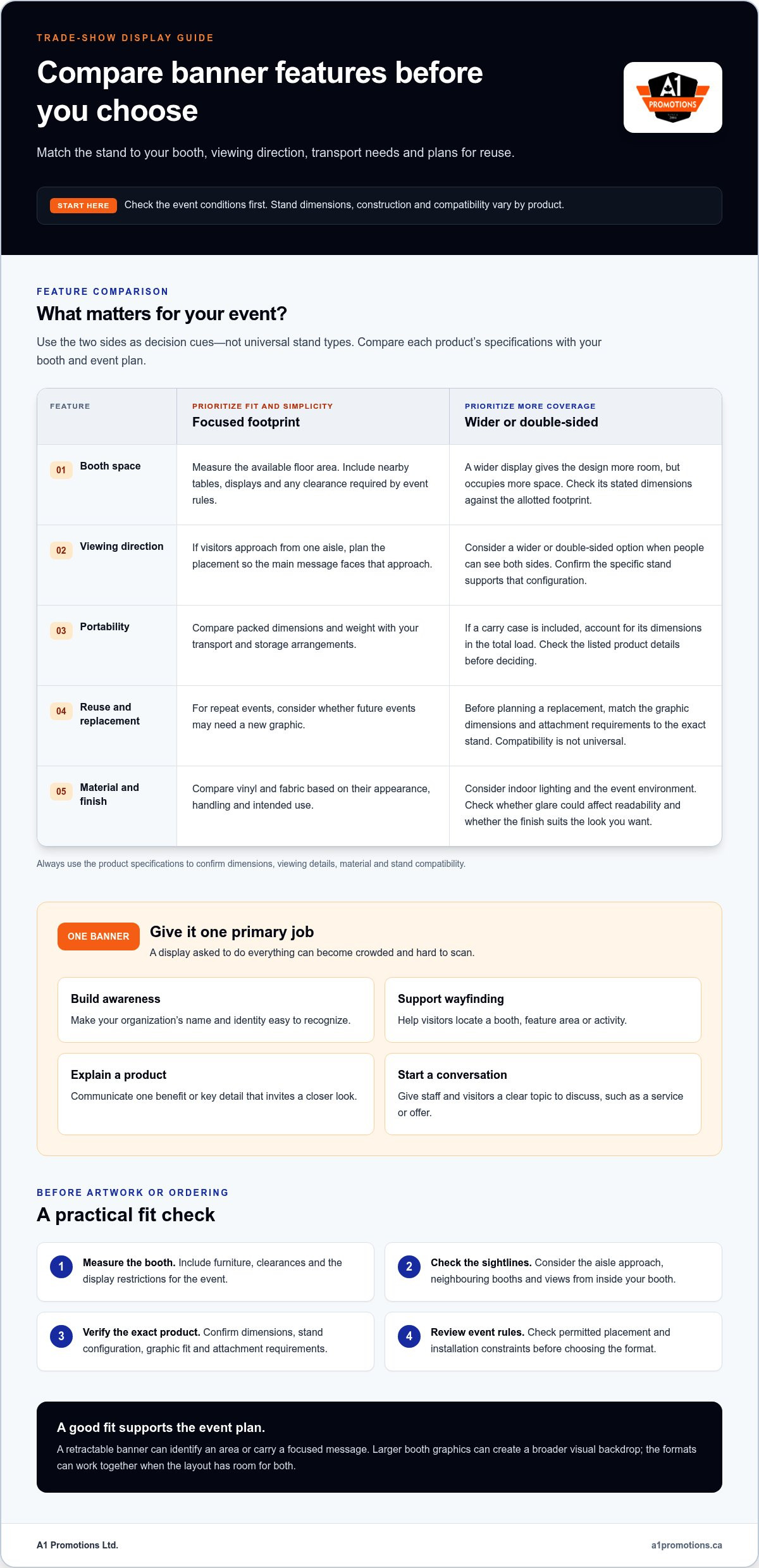
Compare footprint, viewing direction, portability, reuse, material and print finish against your booth layout and event conditions. Use this checklist to narrow your options before you plan artwork or order a display.
Display footprint: Measure the available floor area, including space for people, tables and other displays. Compare the product’s stated dimensions with the event’s display restrictions.
Viewing direction: Consider whether visitors will approach from one aisle or see the display from more than one direction. A wider or double-sided format may be worth considering if its specifications suit the space.
Portability: Compare the listed packed dimensions and weight with your transport and storage arrangements. If a carry case is included, account for its dimensions in the total load.
Reuse: Consider how often you expect to use the display and whether future events may need a new graphic. Check that the graphic and stand are compatible before planning a replacement.
How should you compare size, visibility, and booth space?
Measure the allotted footprint first. Include nearby furniture and any clearances required by event rules, then check how the display will sit relative to aisle and neighbouring-booth sightlines. These checks help you avoid choosing a format that’s difficult to place or partly obscured. They can’t guarantee visitor traffic, but they can help make your message visible from the intended approach.
A wider display may give a design more room, but it also occupies more space. Consider a double-sided option only if people can see both sides and the specific stand supports that configuration. Check dimensions and viewing details in the product specifications rather than relying on a general size assumption.
What should you check about the stand and banner material?
Match portability to your actual travel and storage needs. Product specifications can help you compare weight, packed size and any listed carrying components. For the graphic, consider indoor lighting and the event environment: could glare affect readability, and does the surface and finish suit the look you want? Vinyl and fabric can differ in appearance and handling, so base your choice on the product details and intended use.
Before planning replacement graphics, compare the graphic dimensions and attachment requirements with the exact stand. Compatibility isn’t universal. A mismatch can affect how the graphic fits and displays, even if the measurements seem close.
For an event display that coordinates a banner with other branded materials, explore custom banners and signs from A1 PROMOTIONS LTD (Newton).
Retractable Banner Design: Make the Trade-Show Message Easy to Read
A banner has limited space and often needs to communicate while attendees are moving. Give it a clear visual order: a headline that states the main message, one supporting detail and a next step if the event calls for one. For retractable banners for trade shows, this hierarchy helps visitors grasp the point quickly without reading a block of copy.
Keep the layout focused. Strong contrast between text and background supports legibility, while open space gives each element room to stand out. Choose type that remains readable from the distance visitors are likely to view the banner. Avoid competing headlines, dense paragraphs and small-print details. The goal isn’t to fit every fact on the graphic, but to make the most relevant one easy to find.
What information belongs on a trade-show banner?
Start with the organization, offer or event message you want people to remember. Add only the detail that clarifies or supports that lead message. For example, a banner introducing a product might name the product category and one key benefit instead of listing every specification or related service. This keeps the display useful at a glance and gives staff room to explain more in conversation.
A call to action can guide the next interaction, but include one only when it’s relevant and direct. It might invite visitors to speak with a representative or visit a clearly identified area. Make sure the wording matches what attendees can do at the event. Position the logo and main message prominently, with enough separation that the brand mark doesn’t compete with the headline. Use imagery to reinforce the message, not to decorate the layout at the expense of clarity.
How can you prepare artwork for a large-format display?
Use high-resolution source artwork, especially for logos and images that will be enlarged. Before preparing files, confirm the requirements for the selected production process, including file format, dimensions and colour setup. These details can vary, so don’t rely on settings used for another display. Keep key text and graphics inside the design’s specified safe area, away from edges where they could be crowded or trimmed.
Review the artwork at two scales: close up for spelling, logo versions and alignment, then at a realistic viewing distance to judge whether the headline and supporting text remain clear. Check contrast in the actual colour combination, not just the text content. If a proof is provided, review the layout, copy, colour and image placement before production. A careful final review can catch small errors that stand out on a large graphic.
Before sending the design to production, use this quick check:
- Message: Is the main point clear at first glance?
- Hierarchy: Do the headline, supporting detail and next step read in the right order?
- Branding: Are the correct logo and colours used consistently?
- Legibility: Can the important text be read from the expected viewing distance?
- Files: Do the artwork dimensions and file setup match the selected production requirements?
For branded banners and related event materials, A1 PROMOTIONS LTD (Newton) offers custom banner branding to help keep your display consistent with your event identity.
How to Choose and Prepare a Retractable Banner for Your Event
A practical selection process starts with the event, not the artwork or stand. For retractable banners for trade shows, move from the event brief to booth measurements, then confirm rules, format, artwork and order details. This sequence helps you avoid preparing a design for a display that won’t fit the space or suit the intended viewing direction.
- Define the event brief. Record the event purpose, audience and the one main message the banner should communicate. Decide what you want visitors to notice or do, such as recognize your organization, find a booth area or start a conversation with staff.
- Measure the booth footprint. Note the usable floor area and where the banner could stand without obstructing people, furniture or other displays. Mark the likely approach from the aisle and consider whether the graphic needs to face one direction or more.
- Review event rules and installation constraints. Check permitted display locations, height or placement limits, and any venue instructions that affect setup. Resolve these constraints before selecting a format, rather than adapting the plan after artwork is prepared.
- Gather approved brand assets. Collect the current logo, approved wording, images and brand guidelines. Confirm that the people responsible for the event agree on the message and any call to action before the design is laid out.
- Match the format and material to the plan. Compare product specifications with the measured space, viewing direction, transport arrangements and intended reuse. For broader context on banner materials and design, see this vinyl banner guide.
- Review artwork and plan the order. Check spelling, logo use, layout and file requirements against the selected product. Production specifications and timing depend on the specific product, so use its stated details when planning around the event schedule. Leave time for artwork review and any proofing step offered.
What should you decide before placing an order?
Settle the audience, booth footprint, viewing direction and primary message first. These decisions guide the layout and help keep the artwork focused. A clear call to action can support the event goal, but it should match an action visitors can take at the booth. If you’re still considering banner material, the vinyl banner guide offers additional context.
How do you prepare the display for event day?
Read the selected product’s setup instructions rather than assuming all stands assemble alike. Plan transport and storage around that stand and its supplied components, then check the display position and sightline at the venue before attendees arrive. A small adjustment may help keep the banner visible without interfering with booth activity.
Planning a branded event display? Explore banners and custom branding from A1 PROMOTIONS LTD (Newton) as part of your event preparation.
Plan a Coordinated Trade-Show Display with A1 PROMOTIONS LTD (Newton)
A banner is one part of an event display. Its message and visual style can carry through to other branded materials, helping attendees connect the booth, staff and takeaways with the same organisation. A1 Promotions Ltd. provides banners, signs and custom branding, so event materials can be planned as a coordinated presence rather than as unrelated pieces.
A1 Promotions Ltd. is family-owned and operated and has served customers across Canada since 2004. The company provides expert decoration and customization services. Plan each piece to reinforce the event identity without competing with the banner’s main message.
How can banners work with other branded event materials?
Start with the banner’s primary message, then decide which other items have a useful role in the space. Feather flags can carry event branding beyond the booth area, while custom printed canopy tents can establish a larger branded presence where the event layout allows. The right combination depends on the venue, available space and display rules.
Keep the core elements aligned across materials. Use the same approved logo, colour palette and key wording, and give each item a distinct purpose. For example, a banner might introduce an offer, a flag can support recognition and a canopy can provide a consistent branded setting. Don’t repeat every line of copy across every surface. Related branded merchandise can extend the same visual identity to staff or attendee materials; the Promotional Products Canada branding guide offers further planning context.
For retractable banners for trade shows, coordination doesn’t mean assuming a specific stand feature or package. It means planning the graphic alongside the rest of the display so the banner’s role is clear, the branding feels consistent and the overall arrangement suits the event.
What is the next step for a banner project?
Prepare a short event brief before discussing the project. Include the event purpose, booth dimensions, intended banner position, key message, approved artwork and relevant event display rules. Note which other materials may need matching branding. These details help frame the project around the event’s actual requirements.
A1 Promotions Ltd. provides expert decoration and customization services for banners and related branded materials across Canada. For project and pricing inquiries, discuss your branded event display with A1 Promotions Ltd.. Pricing on the website is being updated. Please call +1 (604) 763‑1500 for accurate pricing.
Put Your Trade-Show Display Plan into Action
Give your banner project a clear starting point: a brief that captures what the event should help your organization achieve. This shifts the decision from choosing a display in isolation to planning how it will support your presence, conversations and brand recognition. A focused brief also gives everyone involved a shared reference as the display takes shape.
Think of retractable banners for trade shows as one visual touchpoint within a broader event identity. Consistent branding can carry across future events and related materials, while each display’s message can be adjusted for its audience and purpose. That balance helps maintain recognition without forcing every event to use identical copy.
When you’re ready to move from planning to a branded display, bring your event brief and artwork direction to A1 PROMOTIONS LTD (Newton). Start planning your trade-show banner and take the next step towards a professional event presence.
Frequently Asked Questions
How much do retractable banners for trade shows cost?
Pricing depends on the selected banner and production details, so a general estimate may not reflect your project. Consider the graphic and display format you need, and use current pricing information rather than relying on an older listing. Pricing on the website is being updated. Please call +1 (604) 763‑1500 for accurate pricing.
Are retractable banners suitable for every trade-show booth?
No. A retractable display may not suit a booth with limited floor space, restricted placement or a layout where the graphic would be obscured. For example, furniture near the aisle in a shared booth may leave little room for a freestanding display. Compare the product’s dimensions with your assigned space and event rules, and consider whether another display approach better fits the booth.
Can retractable banners be reused at multiple trade shows?
They can be used at more than one event if the display remains in suitable condition and the message stays relevant. Before planning reuse, consider whether the graphic includes event-specific dates, promotions or venue details that will become outdated. Follow the product’s care and storage instructions between events. If you plan to use a different graphic later, check its compatibility with the specific stand.
What should I include on a trade-show banner?
Include the organization or offer you want attendees to recognize, plus only the details needed to make that message meaningful. For example, show the company name, a concise description of its service and a relevant way to start a conversation at the booth. Add contact information only if visitors can use it easily, and avoid small text that’s difficult to read from the aisle.
What artwork file is needed for a retractable banner?
There isn’t one file type that applies to every banner. Requirements depend on the product and production process, so prepare the original artwork and confirm the requested format, dimensions and colour setup before submitting it. Avoid using a screenshot of a logo or image when a higher-quality source file is available. Review the final layout at full size or a realistic viewing distance to spot issues.
Can a retractable banner be used outdoors?
Only use one outdoors if the specific product is identified as suitable for the conditions. Don’t assume a display intended for an indoor event will perform the same way outside. Consider exposure to wind, uneven ground and changing weather, as these can affect placement and stability. Check the product’s stated use and any event requirements before setting it up outdoors.
How do retractable banners differ from vinyl banners?
“Retractable” describes a display format, while “vinyl” describes a banner material. The terms aren’t necessarily opposites: a vinyl graphic may be used in a retractable display if it’s compatible with that stand. A vinyl banner can also be made for other display arrangements. Choose based on how the banner will be positioned, the intended use and the specific product specifications.


