
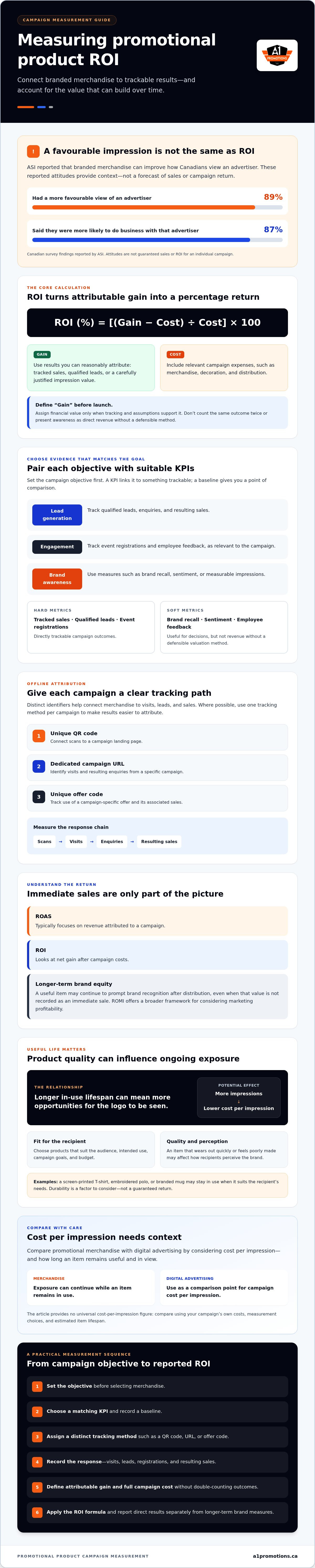
ASI reported in April 2026 that 89% of Canadians have a more favourable view of an advertiser after receiving branded merchandise. But favourable impressions alone don’t prove a campaign paid off. If leadership wants evidence that branded T-shirts, mugs or tote bags generated value, learning how to measure ROI of promo products starts with tracking more than immediate sales. It means following an item’s impact over time.
Offline activity can be difficult to attribute, and not every metric tells the same story. A clear objective and consistent tracking method help connect merchandise to visits, leads or sales, so you can explain where the budget went and what it returned.
This guide lays out the ROI formula, practical tracking options such as unique QR codes, URLs and discount codes, and a framework for comparing promotional product cost per impression with digital advertising. You’ll also see how product quality and useful life affect impressions, giving you a more complete view of campaign performance.
Key Takeaways
- Learn how to measure ROI of promo products with a formula that accounts for campaign costs and attributable returns.
- Separate immediate sales results from longer-term brand equity to assess both near-term performance and lasting value.
- Choose KPIs that match your campaign objective, and distinguish trackable sales and leads from softer measures such as sentiment.
- Use cost per impression to compare merchandise with digital advertising, while considering how long an item stays in use.
- Match products and decoration methods to your audience and campaign goals to support longer-lasting brand exposure.
Understanding the Fundamentals of Promotional Product ROI
How do you show that branded merchandise contributed to business results, not just visibility? To understand how to measure ROI of promo products, start by connecting campaign costs to gains you can reasonably attribute to the items. Those gains may include sales, qualified leads or the value of measurable impressions.
Immediate return on ad spend (ROAS) typically focuses on revenue attributed to a campaign. ROI looks at net gain after costs. Promotional merchandise can also contribute to long-term brand equity: an item that stays useful may continue to prompt recognition after the distribution date, even if that value doesn’t appear as an immediate sale. Return on Marketing Investment (ROMI) offers a broader framework for considering marketing profitability.
For a practical overview, watch this video on measuring promotional product ROI:
The ROI Formula for Branded Merchandise
ROI (%) = [(Gain − Cost) ÷ Cost] × 100
For Canadian campaign reporting, promotional product ROI is the percentage return calculated by subtracting total campaign cost from attributable gain, then dividing the result by total cost. Include all relevant campaign expenses in Cost, such as merchandise, decoration and distribution. Define Gain before launch: it could be the gross profit from tracked sales, the estimated value of qualified leads, or a carefully justified impression value. Don’t count the same outcome twice.
For example, a unique QR code can help connect scans to a landing page, while a campaign URL can identify resulting enquiries. Assign financial value only where your tracking and assumptions support it. Brand awareness matters, but it shouldn’t be presented as direct revenue without a defensible method.
Why Quality Directly Impacts Your Return
An item’s useful lifespan is the period it remains functional and in use. A longer lifespan can create more opportunities for the logo to be seen, increasing total impressions and potentially lowering cost per impression. A screen-printed T-shirt, embroidered polo or branded mug that suits its recipient’s needs may stay in use longer than an item that’s quickly discarded.
Quality also affects perception. If merchandise wears out quickly or feels poorly made, recipients may associate that experience with the brand. A1 Promotions Ltd., a family-run business serving customers since 2004, emphasizes premium-quality custom apparel and promotional items. Product choice and decoration should suit the audience, intended use and campaign budget. Durability isn’t a guaranteed return, but it’s a factor to consider when estimating how long an item may keep generating impressions.
Establishing Key Performance Indicators (KPIs) for Your Campaign
Choose a campaign objective before selecting merchandise. Lead generation, employee engagement and brand awareness each require different evidence of success. A KPI connects the objective to something you can track, while a baseline gives you a comparison point. Without both, it’s difficult to know whether campaign results reflect the merchandise or other factors.
Separate hard metrics, such as tracked sales, qualified leads and event registrations, from soft metrics, such as brand recall, sentiment and employee feedback. Soft metrics can inform decisions, but don’t treat them as revenue unless you have a defensible method for assigning financial value.
Set realistic benchmarks using your own past results and a clearly defined measurement period. Canadian survey findings can provide context, not a guaranteed campaign target: ASI reported in April 2026 that 89% of Canadians surveyed had a more favourable view of an advertiser after receiving branded merchandise, while 87% said they were more likely to do business with that advertiser. These are reported attitudes, not a forecast of sales or ROI for your specific campaign.
Direct Response vs. Brand Awareness
For immediate action, give each campaign a distinct call to action, such as scanning a QR code, visiting a dedicated URL or using a unique offer code. Record scans, visits, enquiries and resulting sales, then compare them with your starting baseline. Use one tracking method per campaign where possible, so results are easier to attribute.
For awareness, ask event attendees a short post-event survey: do they recall the brand, what item did they receive, and have they used or shared it? Tote bags can travel beyond the original recipient, creating pass-along exposure. Treat that as a question to measure through surveys or follow-up research, not as an assumed impression count.
Tracking Employee Engagement and Retention
Custom clothing, such as embroidered polos or screen-printed T-shirts, can support a shared visual identity at work or at events. Track distribution and participation, then pair employee feedback with retention and recruitment data. Compare turnover and recruitment costs against an earlier period, while noting other changes that could affect the results. A change after distribution doesn’t prove the clothing caused it.
For product ideas and considerations, see this guide to custom clothing in Canada. A1 Promotions Ltd. specializes in screen printing and embroidery. If you’re considering branded apparel for a measurable campaign, explore A1 Promotions Ltd.’s branded merchandise.
Before distribution, document the objective, KPI, baseline, tracking method, reporting period and person responsible for collecting results. This simple plan makes it easier to explain how to measure ROI of promo products and compare campaigns consistently.
Calculating Cost Per Impression (CPI) vs. Traditional Media
CPI helps compare the cost of repeated brand exposure across channels, but the estimate is only useful if you state what counts as an impression. For merchandise, use total campaign cost ÷ estimated views over the item’s useful life. If you have several item types, calculate each separately before reporting a campaign-wide average. That shows which items account for the result instead of hiding differences in one blended figure.
Include the same cost categories consistently, and avoid counting one person’s repeated views as separate people reached. Report estimated total impressions separately from unique reach. If you can’t observe actual use, label the result as an estimate and explain the assumptions behind it.
Estimating the Lifespan of Promotional Items
Build estimates from recipient follow-up, distribution context or prior campaign observations rather than a universal view count. A pen handed out at a busy event may be shared or set aside; a branded T-shirt may be worn repeatedly by its recipient. Mugs and hoodies can create frequent exposure in settings where they’re used, but frequency and retention will vary. Use a conservative, central and optimistic scenario to show how assumptions affect CPI.
For more context on merchandise choices, read this Promotional Products Canada guide.
Promo Products vs. Digital Advertising
Compare channels using a consistent reporting period and audience definition. For digital ads, use platform-reported impressions and campaign spend. For merchandise, use your documented impression estimate and full campaign cost. To express either result as cost per thousand impressions, divide cost by impressions and multiply by 1,000. Keep assumptions visible; the figures are estimates of exposure, not proof of attention or conversion.
- Merchandise: a single distribution can continue generating views while an item remains in use. Record item-level estimates and update them if recipient feedback changes your assumptions.
- Digital advertising: delivery depends on campaign settings and placement. Compare reported impressions over the paid campaign period, and distinguish them from clicks or completed actions.
Physical items don’t rely on a live ad placement to remain visible, though they can be unused or discarded. Digital ads can be adjusted or paused, while merchandise is distributed in advance. Bulk screen-printed T-shirts may simplify per-item costing across a larger order, but calculate the full campaign cost and avoid assuming every recipient will wear one. A1 Promotions Ltd. specializes in screen printing and embroidery, with a premium-quality focus.
Practical Methods to Track Conversions and Engagement
Connect each item to a trackable action before distribution. A QR code, campaign-specific URL or unique coupon code can show whether recipients responded. Label every link and offer by campaign so you can compare results in your analytics and CRM. A scan or click is a response, not necessarily a sale, so track what happens next.
- QR codes: Link to a campaign landing page, registration form or offer. Use a distinct code for each event or item type.
- Vanity URLs: Print a short, memorable address unique to the campaign. Record visits and the actions visitors take.
- Promo-only coupon codes: Assign a separate code to each distribution. Calculate redemption rate as redemptions divided by codes distributed, and report the period measured.
- Social campaigns: Invite recipients to tag your account or use a campaign hashtag to enter a branded-item giveaway. Track valid entries and engagement, and distinguish these interactions from leads or sales.
Digital Integration for Physical Products
Place a QR code on a custom hoodie where it's easy to see and scan, such as a flat, unobstructed area. Avoid seams, folds and placements that distort the code during wear. Test the finished decoration on different phones before distribution, and make sure the destination page works on mobile.
A dedicated campaign landing page can be omitted from your main navigation while still being accessible through the printed code or URL. Include a clear next step, such as completing a form, and use analytics tags to identify the campaign source. Don't treat total page visits as unique people unless your reporting supports that distinction.
A1 Promotions Ltd. specializes in screen printing and embroidery and emphasizes expert service. Discuss placement and decoration requirements when planning branded apparel, so the design remains clear and any printed code can be tested for scanning.
Lead Attribution and CRM Integration
Ask staff to record which event or item prompted each enquiry. Add a consistent campaign tag to the CRM record, then follow the lead through qualification, conversion and revenue. To compare gifted leads with cold leads, use the same conversion window and calculation for both groups: converted leads divided by total leads. Keep the groups and criteria consistent.
For corporate gifts, track recipient accounts, gift dates, renewals and account value over a defined period. Compare retention among recipients with an appropriate comparison group, but don't assume the gift caused a difference. This gives you a more complete view of how to measure ROI of promo products beyond immediate scans.
Planning apparel or promotional items for a trackable campaign? Explore custom apparel and promotional items with A1 Promotions Ltd..
Optimizing Your Strategy for Maximum Return
The strongest product choice is the one recipients will use. Start with their routines, the setting and the campaign objective. Custom headwear may suit outdoor events or team apparel; travel mugs or personalized water bottles may fit a daily commute or workplace. Neither category guarantees the highest ROI. Compare options by audience relevance, expected use and how well you can track campaign results.
Decoration should also match the item and its expected use. Embroidery can be suitable for polos, jackets and headwear, while screen printing works for items such as T-shirts. Consider the design, garment and intended wear before choosing. A decoration method that suits the product can help it remain presentable in regular use, supporting longer-term exposure.
Selecting High-Impact Categories
Evaluate product options against practical criteria before ordering:
- Audience fit: Does the item meet a real need or suit the recipient’s lifestyle?
- Use and visibility: Is it likely to be used where others may see the branding?
- Measurement: Can you connect distribution to scans, responses, leads or another defined KPI?
- Coordination: Can sourcing apparel, awards and signage through one supplier simplify administration?
A one-stop shop may reduce the work involved in coordinating separate suppliers, though the actual benefit depends on your project. For embroidery considerations, see this guide to professional embroidery.
Working with A1 Promotions
A1 Promotions is a family-run business serving customers since 2004, with expertise in screen printing and embroidery. When discussing a campaign with a merchandise partner, ask about product suitability, decoration options, sourcing and how the proposed choices align with your audience and measurement plan. A premium-quality focus can help you assess durability alongside the campaign’s cost, rather than choosing on unit price alone.
Plan around your event date, but confirm production and delivery timing with the supplier before finalizing the campaign. Fast turnaround isn’t guaranteed; allow time for approvals and tracking details such as QR codes or campaign URLs. This helps ensure the merchandise is ready for the period you intend to measure.
Use the same audience, objective and KPI framework established earlier to compare product choices. That keeps how to measure ROI of promo products tied to campaign evidence, not assumptions about which item performs best.
For custom apparel, awards, signage and other branded merchandise, contact A1 Promotions about quality branded merchandise that gets noticed.
Put Your Promo Product ROI Plan into Action
Measuring merchandise performance starts with a clear objective, a realistic estimate of useful impressions and a way to connect responses to the campaign. Use the same assumptions when comparing promotional items with digital advertising, and separate tracked sales or leads from longer-term measures such as recall and engagement. That gives leadership a more complete view of how to measure ROI of promo products.
Product fit and quality matter, too. Merchandise that suits its audience and stays in use longer has more opportunities to generate impressions, though actual results depend on how recipients use it. A1 Promotions is family-owned and operated, serving customers since 2004 with premium-quality sourcing and over 20 years of branding experience.
Ready to plan a campaign around lasting impressions? Get a quote for high-impact promotional products from A1 Promotions. Set a measurable goal, choose merchandise with care and build a tracking plan that helps you make your next campaign even stronger.
Frequently Asked Questions
How do you calculate ROI for promotional products?
Subtract total campaign cost from the gain attributable to the campaign, divide by total cost, then multiply by 100. The formula is ROI (%) = [(Gain − Cost) ÷ Cost] × 100. Include relevant expenses, such as merchandise, decoration and distribution. Define the gain before launch: it could be tracked sales, qualified leads with an assigned value, or a supported estimate of impression value. Avoid counting the same result twice.
What is a good ROI for a promotional product campaign?
There’s no single ROI benchmark that applies to every campaign. A useful target depends on your objective, audience, costs, measurement period and how you value outcomes. Set a baseline and target before distribution, then compare actual results with both. For an awareness campaign, report recall or engagement separately from revenue. For a sales-focused campaign, use attributable sales or profit. Be transparent about assumptions rather than presenting estimates as guaranteed returns.
Can I track ROI on promotional items using QR codes?
Yes. Give each campaign or distribution a unique QR code that leads to a mobile-friendly page, registration form or offer. Track scans and the actions that follow, such as enquiries, sign-ups or purchases. A scan shows engagement, not necessarily a conversion, so connect the landing-page activity to analytics or CRM records where possible. Test the code and destination before distribution, and label campaign sources consistently.
How does the cost per impression of promo products compare to digital ads?
Compare them by dividing each channel’s total cost by its measured or estimated impressions, then express the result per thousand impressions if you’re comparing CPM. Digital platforms report campaign impressions; merchandise requires an estimate of views over an item’s useful life. Include your assumptions and use comparable audiences and time periods. Physical items may remain visible after distribution, but actual use and exposure vary, so don’t treat projected impressions as guaranteed.
What promotional items have the highest ROI?
No product category guarantees the highest ROI. The best choice depends on whether the item fits the audience’s routines, campaign objective and distribution setting. A travel mug or personalized water bottle may be useful to some recipients, while custom headwear or a screen-printed T-shirt may suit an event or team. Compare expected use, visibility, durability and trackability. Estimate performance using your own campaign data instead of relying on a universal ranking.
How do you measure brand awareness from branded merchandise?
Measure awareness with a baseline and follow-up, not impressions alone. Ask a consistent sample of recipients whether they recall the brand, recognize the logo or remember receiving the item. You can also track campaign-page visits, branded search activity or social engagement, while noting that these signals may have other causes. Report survey results separately from sales and explain who was surveyed, when, and how responses were collected.
Does the quality of the product affect the ROI?
It can affect potential return by influencing whether an item remains useful, presentable and in circulation. A durable branded item may generate more opportunities for exposure over time, which can lower estimated cost per impression. Quality alone doesn’t prove ROI, though. Consider audience fit, decoration, use and campaign tracking together. Compare recipient feedback and observed use with your original assumptions, and avoid promising a lifespan you haven’t verified.
What are the most common mistakes when measuring promo ROI?
Common mistakes include distributing merchandise without setting an objective, counting every impression as a sale, and using unsupported estimates for an item’s lifespan. Other errors include leaving decoration or distribution expenses out of campaign cost, failing to use unique tracking codes, and comparing results across different time periods or audiences. Set KPIs first, document assumptions, track outcomes consistently and separate measured results from estimates in your report.


